For most families, a dog carrying sticks into the house is a minor annoyance. But for the Calder family of Fort Collins, Colorado, their shepherd mix, Riley, turned the habit into a ritual so persistent that it eventually revealed something far more unexpected than chewed bark on the carpet.
It started in early spring, right after snowmelt. Riley returned from the yard holding an unusually smooth, dark stick—short, straight, and different from the rough cottonwood branches scattered around the property. The family tossed it aside, assuming she’d found a leftover scrap from winter pruning. But the next day, she brought the exact same stick back, placing it carefully at the sliding door, looking at her owners as if waiting for acknowledgment.
By the end of the week, Riley had delivered the stick five separate times, even after the family intentionally threw it deep into a brushy corner of the yard to stop the routine. Somehow, she always retrieved the same one, identifiable by a knotless surface and the slightly tapered end worn smooth with age. When the Calders inspected the backyard, they couldn’t locate any other sticks resembling it.
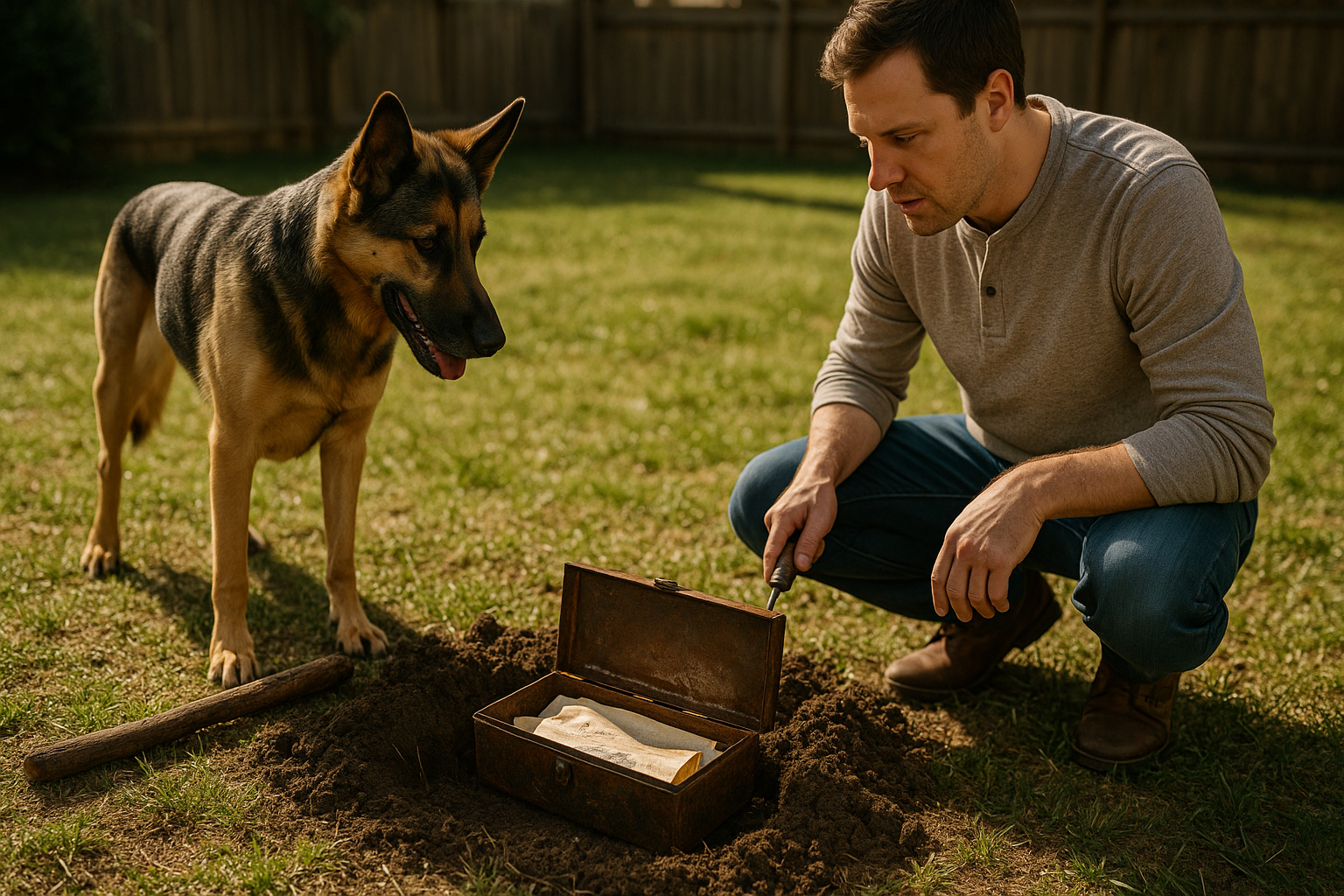
Riley’s insistence turned from curious to concerning when she began whining for the family to follow her outside. She trotted to the far back of the yard, dropped the stick in the same precise spot, and stared expectantly at the ground. When the Calders failed to react, Riley began pawing at the dirt, pacing in tight circles, returning repeatedly to the single area marked only by patchy grass and a leaning fence post.
On a Saturday afternoon, finally giving in to the dog’s persistence, Tom Calder grabbed a small gardening trowel and joined Riley at the spot. He expected a rodent nest or a root tangle, maybe even an old sprinkler pipe. Instead, he hit something hard just two inches beneath the surface. At first he thought it was stone, but the texture felt too smooth and straight-edged. He brushed away more soil until a rectangular corner emerged—a fragment of metal glinting softly beneath the dirt.
Using the trowel and his hands, he unearthed a long, rusted metal box roughly the size of a shoebox. Its lid was fused with corrosion, but a faint stamped imprint hinted it had once been a lockbox. Riley hovered close, tail stiff but wagging in short bursts, her nose brushing the soil as Tom worked. When he finally pried the box open with a flathead screwdriver from the garage, the family found the interior carefully lined with layers of waxed paper. Inside were brittle envelopes, a folded cloth, and several slips of yellowed carbon-copy forms.
The documents were dated 1964 through 1971—decades before the Calders bought the property. Most appeared to be receipts, letters, and land agreements connected to the home’s original owner. But one item stood out: a detailed sketch of the property boundaries showing an older fence layout and a note reading, “Keep separate until dispute resolved.” Another envelope contained correspondence referencing a long-ago survey error that temporarily misidentified ownership of the back ten feet of the yard.
On Monday, Tom contacted the county clerk’s office. A property records analyst confirmed the documents aligned with a historical land dispute involving the previous subdivision owner. The issue had been formally corrected years later, but the original owner apparently created a personal record during the process—then buried it on the disputed strip of land. According to the county historian, such hidden “property archives” were not unheard of in mid-century disputes, though few were discovered intact.
The analyst suggested Riley likely located the buried box due to trace organic scents escaping through the thinning soil as winter moisture receded. Dogs are known to detect metal oxidation, decaying paper fibers, or even subtle temperature differences in disturbed earth—factors humans would never notice.
For the Calders, the discovery resolved a month-long puzzle about their dog’s fixation with a single stick. The stick, it turned out, wasn’t a stick at all. It was a fragment of the rotted wooden slat originally marking the old boundary line on the sketch. Riley had found the lone surviving piece, carried it proudly to her humans, and then insisted they investigate its origin.
Officials have since added the recovered documents to the county historical archive, though they note the case posed no ongoing legal concerns. Still, the Calders say the experience changed the way they see their backyard—and their dog.
Sometimes, a stick isn’t just a stick. And sometimes, a family pet uncovers the last chapter of a story buried long before they arrived.