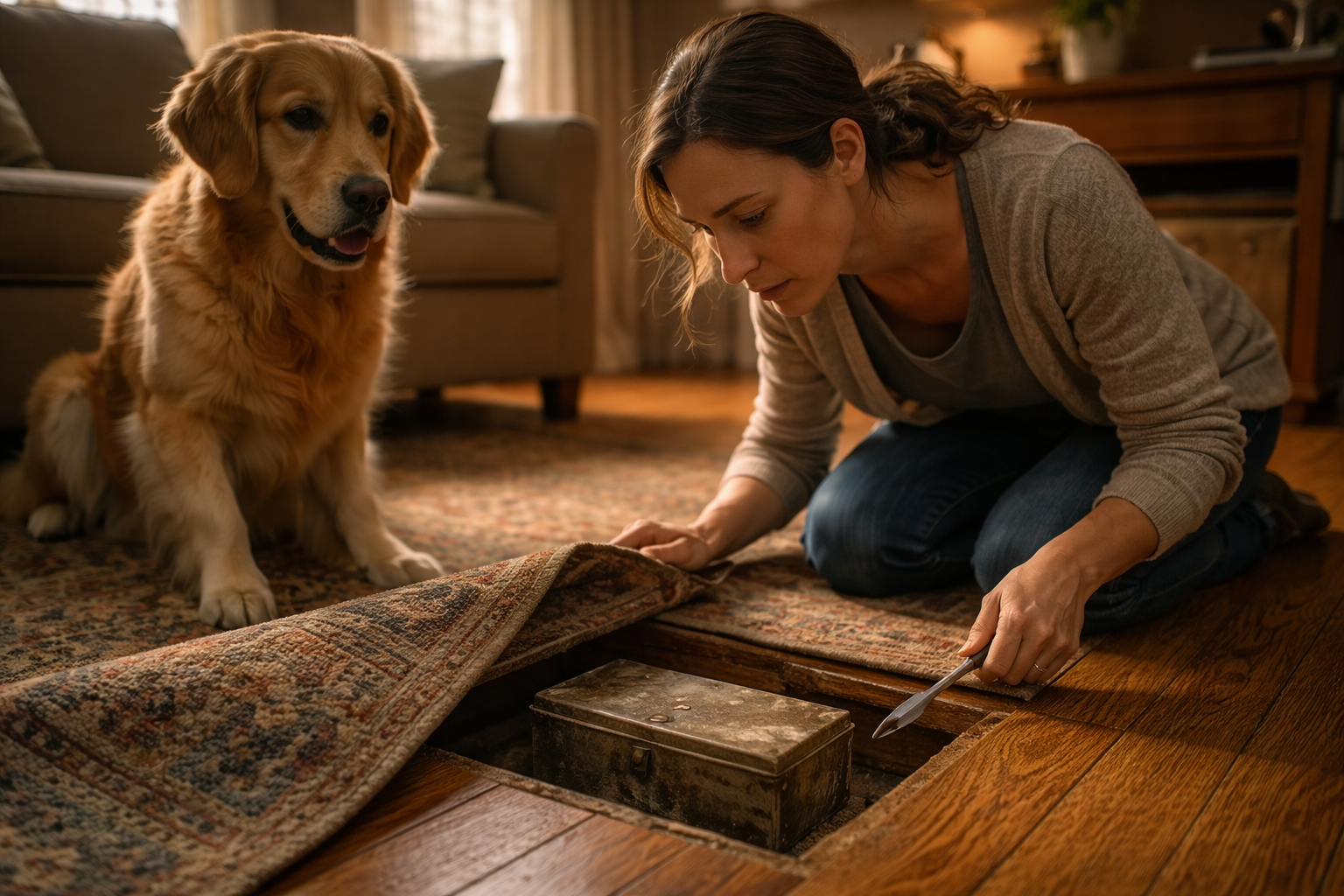
It started as a small annoyance. The Mitchell family’s golden retriever, Daisy, had developed an odd habit—scratching at the corner of the living room rug. It wasn’t just a casual scratch here and there; it became an obsession. Daisy would walk over to the rug every morning, sit, and dig at the fibers with her paws as though trying to uncover something hidden beneath. At first, the family thought it was simply a behavioral quirk—a way for Daisy to release pent-up energy or an attempt to “arrange” her territory in the house.
But as the days passed, the scratching grew more intense. Daisy began to whine softly, a sound that was both anxious and insistent, each time she sat by the rug. Her behavior grew so persistent that she eventually ignored the food bowl, opting instead to spend hours in the living room, scratching, pawing, and staring at the same corner of the rug.
Concerned, Sarah Mitchell, the family’s matriarch, decided to take a closer look. Daisy had been a part of their family for years, and this was a behavior they had never seen before. The rug in question wasn’t new—it had been there for as long as they had lived in the house. There was no visible reason for Daisy’s sudden obsession with it. Sarah assumed that perhaps something had fallen underneath it or that there was a hidden object causing the commotion. With a skeptical shrug, she pulled back the rug to inspect the floor.
At first, there was nothing. Just the familiar hardwood flooring, scuffed from years of use, and the faint smell of dust. But as Sarah bent down closer, she noticed something odd. The corner of the floor, where Daisy had been scratching, appeared to be slightly elevated. The wood looked subtly different, as if it was no longer flush with the surrounding boards. Sarah ran her fingers across the edge and realized that the corner of the board was not fixed in place. It gave slightly, as if something was wedged underneath it.
Intrigued and a little nervous, Sarah grabbed a screwdriver and carefully pried at the corner of the floorboard. It came loose with a soft creak, revealing a hidden compartment. The opening was narrow but deep enough to reveal a small, rectangular box. It was covered in dust, its surface worn and scratched, but it looked remarkably old. Sarah’s heart raced with curiosity as she carefully pulled the box free from its resting place.
With the box in her hands, she called her husband, Daniel, into the room. Together, they examined the small metal box. It wasn’t locked, but it was tightly sealed, and Sarah could feel the weight of something inside. Using a butter knife, they pried it open, revealing a stack of yellowed papers, several photographs, and an envelope addressed to “The New Homeowners.”
Inside the envelope was a letter, written in elegant cursive. The handwriting was old, perhaps dating back several decades, and the paper had browned with age. The letter read:
“If you find this, know that we never wanted to leave. This house has seen many secrets, and some must remain hidden. The history here is deep, but so are the regrets. Please take care of what you discover.”
The letter, chilling in its vagueness, was signed only with the initials “J.S.” Below the letter was a series of photographs showing the house in its earlier years, before any modern renovations. The photos were black and white, depicting the original owners, a couple who had lived there decades ago, standing proudly in front of the house. In one of the photographs, the man appeared to be holding the same box they had just uncovered, but the area beneath the floorboards was different—it was a room that no longer existed.
Sarah and Daniel spent the next few hours poring over the documents. They discovered that the house had once been much larger and had undergone several renovations in the 1940s. The documents included blueprints, detailing a hidden room in the basement—a room that had been walled off and forgotten. The blueprints matched the house’s current layout, showing that the room had been sealed long before the Mitchells moved in.
When Sarah contacted the local historical society, they confirmed the existence of the original room. According to their records, the room had been sealed off after a personal tragedy involving the house’s former owners. No one had dared to speak of it, and the room remained hidden, a silent witness to the past.
The discovery sent a ripple through the Mitchell family. Not only had they uncovered a physical object hidden under their floorboards, but they had also unearthed a piece of the house’s history—a history filled with mystery and secrets.
As for Daisy, her behavior became less obsessive once the box was removed. It was as if she had been protecting a part of the house’s past, drawn to the hidden compartment long before anyone else noticed it.
For the Mitchells, the discovery raised more questions than answers. What had happened in that sealed room? Why had it been hidden for so long? And what other secrets might their house be keeping?
The Mitchells now find themselves walking through their home with a different sense of awareness. Every creaky floorboard and misplaced draft seems to hold more meaning. They’ve come to realize that some homes carry stories long after the people who lived in them have gone. And sometimes, it’s a dog’s persistent instincts that bring those stories to light.