It was a Tuesday afternoon like any other at the chaotic municipal shelter in Chattanooga, Tennessee. The kennels were at capacity, the noise level was deafening, and intake staff were bracing for another wave of strays. When a scruffy, matted senior dog was brought in by a concerned citizen who found him wandering near a highway underpass, the expectations were low. He looked like a lifelong stray—weather-beaten, limping, and seemingly forgotten by the world.
The intake coordinator, Sarah Jenkins, followed the standard protocol. She lifted the heavy, tired dog onto the metal exam table to check for vitals and, crucially, to scan for a microchip. Most of the time, especially with dogs in this condition, the scanner remains silent. But this time, a sharp beep echoed through the exam room.
What Jenkins found on the screen didn’t just identify the dog; it unraveled a mystery that had remained unsolved for nearly a decade. This wasn’t just a lost dog—this was the center of a miracle microchip reunion that would leave the entire staff in tears.
The Moment Everything Changed
When the scanner beeped, Jenkins felt a flicker of hope. "Usually, if we get a chip on a dog looking this rough, the information is a dead end," Jenkins told local reporters later. "The phone numbers are disconnected, or the owners surrendered the animal years ago. But you always have to look."
Upon entering the identification number into the national pet recovery database, the screen populated with data that made Jenkins pause. The dog’s name was "Cooper." But it was the "Date Reported Missing" that made her heart skip a beat: October 14, 2016.
Cooper hadn’t just been lost for a few weeks; he had been missing for over seven years. According to the database notes, he had vanished from a backyard in Georgia—over 200 miles away—during a severe thunderstorm. The owner on file, a man named Robert, had flagged the chip as "lost" and had updated his contact information every year since, refusing to believe his best friend was gone forever.
The Phone Call of a Lifetime
Shelter staff gathered around as Jenkins picked up the phone. It is a policy to temper expectations, but the updated contact info suggested an owner who still cared. When the voice on the other end answered, Jenkins identified herself and asked if he was the owner of a Golden Retriever mix named Cooper.
There was a long silence on the line. According to witnesses in the office, the man’s voice cracked as he asked, "Is he alive?"
Robert had spent the first two years searching every shelter in three states. He had put up thousands of flyers. Even after moving for work, he kept his phone number the same solely in the hopes that one day, this exact call would come. "I never stopped looking," Robert later shared with the shelter staff. "Everyone told me to move on, that he was likely gone. But I just had this feeling."
The Bond Between Humans and Animals
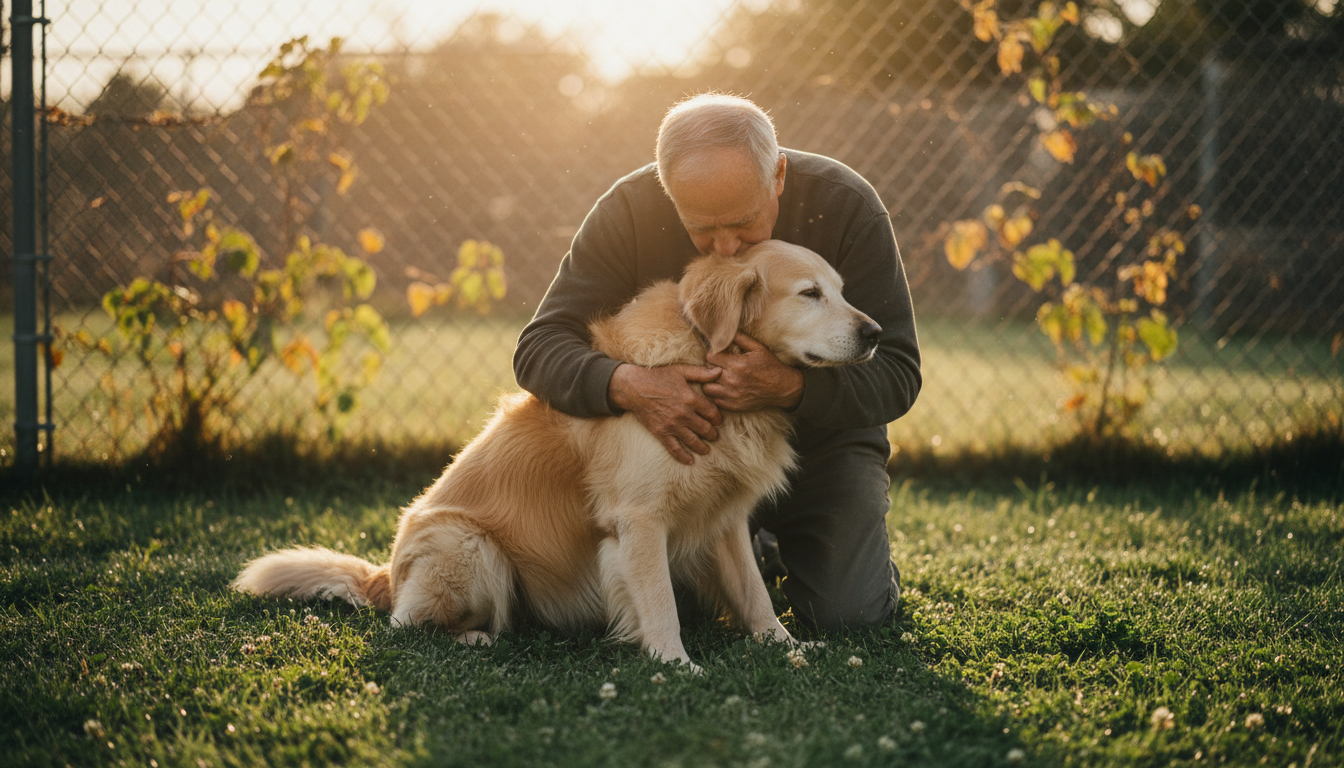
The reunion that followed was a testament to the enduring memory of dogs. Robert drove four hours through the night to reach the shelter as soon as it opened the next morning. The staff was worried; Cooper was old now. His muzzle was grey, his eyes were cloudy with early cataracts, and he moved stiffly with arthritis. Would he even recognize the young man who had raised him?
Staff members brought Cooper out into the play yard. He kept his head low, sniffing the grass, indifferent to the humans around him. Then, Robert stepped into the enclosure and whistled—a specific, two-note whistle he used to use at dinner time.
Cooper’s head snapped up. His ears pricked forward. Despite his stiffness, the old dog began to trot, then run, towards the sound. When he reached Robert, he didn’t jump—he was too old for that—but he pressed his forehead deep into Robert’s chest, letting out low, happy whines. It was a moment of pure connection that confirmed the bond had never broken, despite the seven years and hundreds of miles between them.
Impact on the People and Community
Stories like Cooper’s serve as a powerful morale booster for shelter workers who often deal with heartbreaking cases of neglect and abandonment. "We see the worst of humanity sometimes," said the shelter director. "But then we see this. A man who waited seven years, and a dog who remembered him. It reminds us why we do this work."
The story quickly spread through local social media groups, highlighting the critical importance of microchipping. It wasn’t just about having the chip; it was about Robert’s diligence in keeping the information current. The shelter used the viral moment to host a low-cost microchipping event the following weekend, chipping over 200 local pets who might otherwise have gone unprotected.
Background & Credible Sources on Microchipping
While Cooper’s story feels like a movie script, the technology behind it is grounded in simple, effective science. According to the American Veterinary Medical Association (AVMA), dogs without microchips are returned to their owners only 21.9% of the time. However, microchipped dogs are returned to their families 52.2% of the time. The gap is significant.
Furthermore, the primary reason microchipped animals are not returned is incorrect contact information in the distribution database. Cooper’s story emphasizes that the chip is only as good as the data connected to it. "It’s a tiny grain of rice that acts as a lifeline," explains Dr. Emily Sato, a veterinarian consulted for this story. "It doesn’t track GPS, it doesn’t need a battery. It just waits to be scanned. In Cooper’s case, it waited seven years to do its job."
For those interested in learning more about pet safety, you can read our guide on essential safety tips for new owners to ensure your furry friends stay safe.
What Happens Next
Cooper is now back home, living out his golden years on a soft orthopedic bed rather than the hard concrete of a kennel or the dangerous streets. Robert reports that despite the time apart, Cooper immediately remembered the layout of the house and his old spot on the rug.
The shelter staff in Chattanooga have pinned a photo of the reunion on their bulletin board—a reminder that miracles do happen, usually when you least expect them, starting with a simple beep of a scanner.