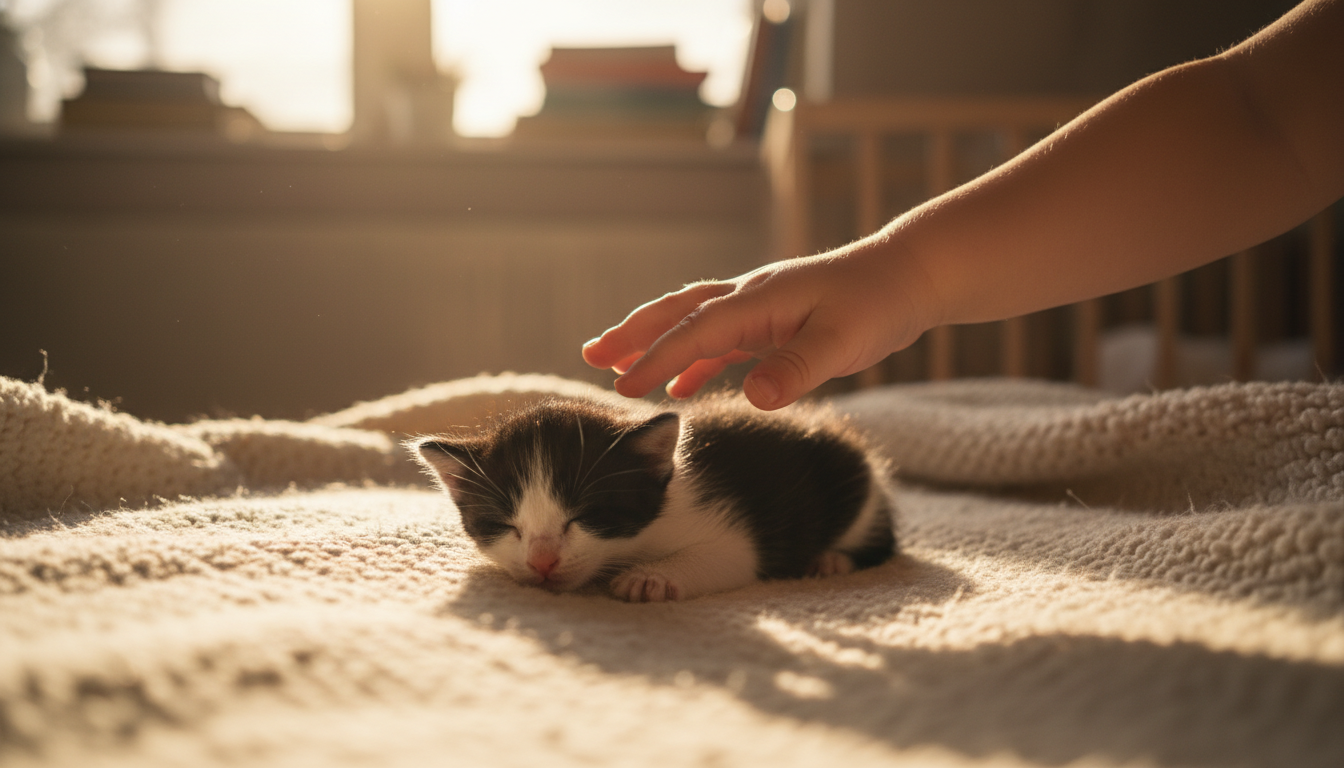
For the Thompson family, the silence in their suburban Ohio home had become deafening. Following the passing of a beloved grandmother and the loss of their fourteen-year-old Golden Retriever within the span of three months, the household had settled into a protective numbness. Conversations were superficial, avoiding the heavy air of grief that hung over the dinner table. It was in this atmosphere of unspoken sorrow that a 200-gram ball of fur named Barnaby arrived, and fundamentally shifted the family’s understanding of life, death, and the courage it takes to love again.
A Decision Born from Silence
The decision to foster wasn’t made lightly. according to Sarah Thompson, the mother of two, the idea came from a desperate desire to inject life back into a home that felt stagnant with mourning. “We weren’t ready to own another pet,” she explained. “The pain of losing Buster was too fresh. But the local shelter put out a plea for emergency fosters for bottle babies, and something just clicked. We thought it would be a temporary distraction.”
The benefits of fostering are often touted in terms of saving animal lives, but for the Thompsons, the saving went both ways. They brought home Barnaby, a black-and-white tuxedo kitten who had been found abandoned in a cardboard box behind a grocery store. He was estimated to be less than two weeks old, his eyes barely open, crying with a ferocity that belied his tiny stature.
The Fragility of Life
Barnaby was not a healthy kitten. From the first night, it became clear that this was not going to be a simple case of feeding and cuddling. He struggled to latch onto the bottle and showed signs of upper respiratory distress. The family was suddenly thrust into a round-the-clock care routine, rotating shifts to ensure he was kept warm and fed every two hours.
For the Thompson children, ages eight and twelve, this was a confrontation with reality they had been trying to avoid. “At first, I didn’t want them to get attached,” Sarah admitted. “I was terrified that if Barnaby didn’t make it, it would break them completely after everything we’d been through.”
According to the Cornell Feline Health Center, mortality rates in orphaned neonatal kittens can be high, often referred to as “fading kitten syndrome.” Without a mother’s antibodies and constant warmth, these neonates occupy a precarious space between life and death. The family was forced to operate in this liminal space, watching the kitten fight for every breath.
The Conversation Shifts
The turning point came on the fourth night. Barnaby had become lethargic and refused to eat. The youngest child, Leo, sat by the incubator, watching the kitten’s shallow breathing. Instead of ushering him away, Sarah sat down beside him.
“Is he going to die like Grandma?” Leo asked. In the past, the family might have offered vague reassurances or changed the subject. But the immediate, tangible struggle of the foster kitten demanded honesty.
“He might,” Sarah told her son. “But he is warm, and he is loved right now. And that matters more than anything.”
This marked a pivotal shift in the family dynamic. The focus moved from the fear of the end to the value of the present moment. They began talking openly about their fears. They discussed what it meant to care for someone who might leave, and how the pain of loss is the price paid for the joy of connection.
A Community of Support
The Thompsons were not alone in their struggle. They relied heavily on support from the shelter staff. According to rescue coordinators at the local humane society, foster families often serve as a bridge for animals that would otherwise be euthanized due to lack of resources. “Fosters take on the emotional burden that shelter staff simply don’t have the bandwidth for,” a shelter representative noted. “They provide the miracle of a home environment, which is often the only medicine that works.”
The family also utilized resources from the ASPCA’s newborn kitten care guide to refine their technique, learning how to stimulate the kitten for digestion and manage his temperature. The technical aspect of the care gave the children a sense of agency. They weren’t helpless observers of tragedy; they were active participants in a rescue mission.
The Miracle of Recovery
Against the odds, Barnaby began to improve. The antibiotics kicked in, his appetite returned with a vengeance, and his personality began to emerge. He transformed from a fragile, fading entity into a chaotic force of nature, climbing pant legs and chasing imaginary dust motes.
The relief in the household was palpable, but it was different than before. It wasn’t just relief that he survived; it was a profound appreciation for his vitality. The shadow of grief that had covered the house hadn’t disappeared, but it had been illuminated. The family realized that while they couldn’t control death, they could absolutely control how much love they poured into life while it was there.
Why This Matters
Psychologists have long studied the link between animal caretaking and emotional healing. Caring for a vulnerable animal can increase levels of oxytocin and reduce cortisol, but more importantly, it provides a narrative framework for processing complex emotions. For the Thompsons, the foster kitten acted as a proxy, allowing them to externalize their grief and manage it in real-time.
“We learned that it’s okay to talk about the scary stuff,” Sarah said. “Barnaby taught us that loving something fragile is brave. We stopped tiptoeing around our loss and started sharing memories of Grandma and Buster again, usually while watching Barnaby do something ridiculous.”
The Happy Ending
Eight weeks after he arrived, Barnaby was healthy, vaccinated, and ready for adoption. This presented the final challenge: saying goodbye. In the past, this separation might have been viewed as another trauma. However, the family viewed it differently this time.
They attended adoption day together. When a young couple fell in love with Barnaby, the tears shed by the Thompson family were bittersweet but proud. They had taken a life on the brink of fading and shepherded it to safety. They had faced the possibility of loss head-on and chosen to love anyway.
The experience didn’t erase their grief, but it integrated it. They continue to foster for the shelter, taking in the “hard cases” that others might shy away from. As the stories of rescue animals often show us, the rescuer is frequently the one who ends up being rescued.
“We talk about Grandma all the time now,” Leo mentioned during a follow-up visit with the shelter. “And we talk about Barnaby. It’s sad that they aren’t here, but it’s happy that we knew them.”