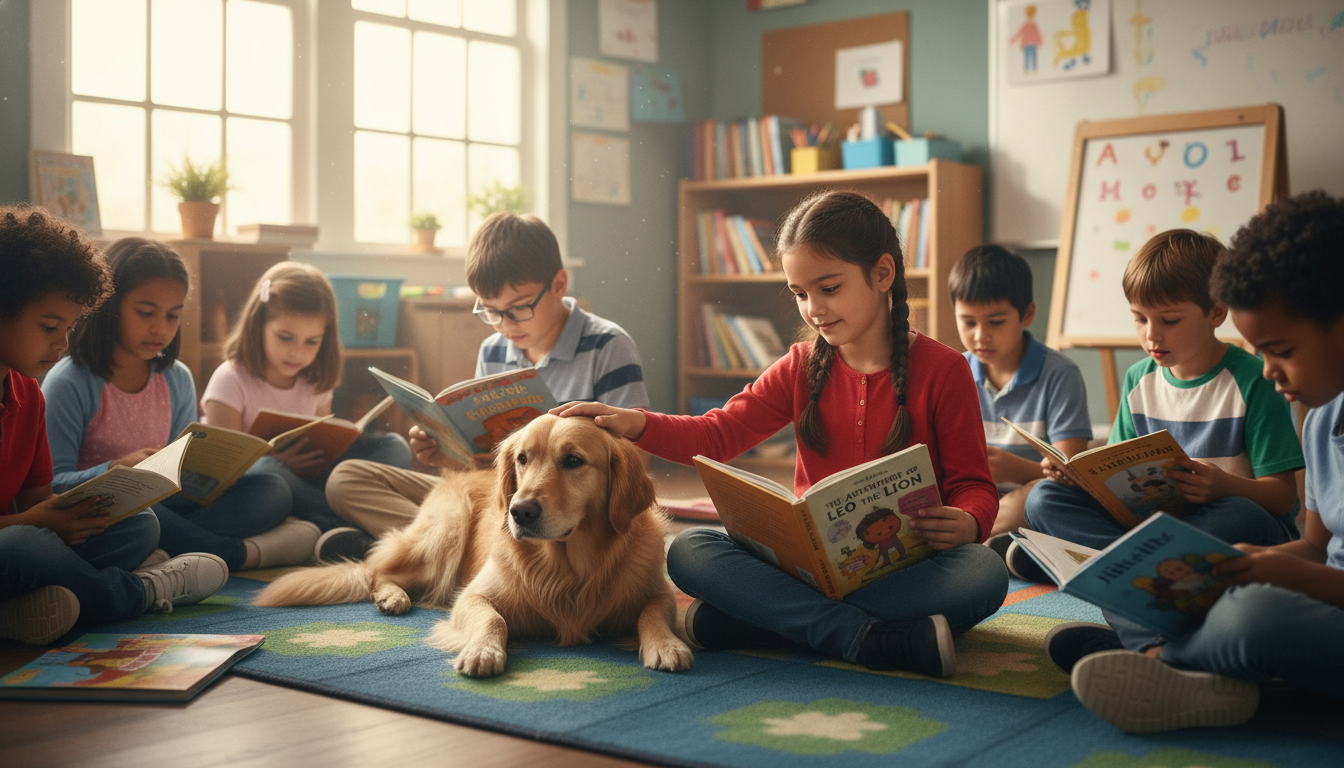
In a bustling second-grade classroom at Maplewood Elementary, amidst the scratching of pencils and the shuffling of papers, there is a student who never raises his hand. He doesn’t speak out of turn, he doesn’t run in the halls, and he spends most of the math hour sleeping under a desk. His name is Barnaby, and he is a three-year-old Golden Retriever whose presence is revolutionizing the way children learn, connect, and heal.
Barnaby is not a pet, nor is he a distraction. He is a certified classroom therapy dog, a rapidly growing phenomenon in educational settings across the country. For the students in Room 204, he is a furry anchor in an often chaotic world, providing a silent, non-judgmental support system that human teachers, for all their skills, sometimes cannot replicate. The impact of animals in educational environments is becoming undeniable, shifting from a novelty to a critical tool for emotional regulation and literacy improvement.
The Quiet Presence That speaks Volumes
The concept of a classroom therapy dog is grounded in the idea of co-regulation. When students—particularly those facing anxiety, trauma, or learning disabilities—enter a high-stress environment like a classroom, their cortisol levels can spike, making learning nearly impossible. According to the Alliance of Therapy Dogs, the simple act of petting a dog can lower blood pressure and heart rate, releasing oxytocin in both the human and the animal.
In Room 204, the teacher, Mrs. Henderson, utilizes Barnaby as a bridge for students who are struggling to engage. "We had a student, Leo, who wouldn’t speak for the first three weeks of school," Mrs. Henderson explained in an interview regarding the program’s success. "He was terrified of making a mistake. Then, one morning, Barnaby rested his head on Leo’s shoe. By recess, Leo was whispering to the dog. By the end of the week, Leo was reading aloud to Barnaby because he knew the dog wouldn’t correct his pronunciation."
This anecdote aligns with broader findings from educational psychologists. When children read to dogs, the pressure of performance vanishes. The dog acts as a passive listener, interested only in the connection, not the syntax. This creates a psychological safety net that allows confidence to bloom where it was previously stifled.
From Shelter to School: The Rigorous Journey
It is important to distinguish between a family pet and a working facility dog. Barnaby’s journey to the classroom began long before he stepped onto the linoleum floors of Maplewood. Most facility dogs undergo up to two years of specialized training.
According to organizations like Assistance Dogs International, these animals are trained to remain calm in high-stimulation environments. They must ignore dropped food, loud noises, sudden movements, and the unpredictable energy of thirty children. They are conditioned to seek out those who are stressed—a behavior often described as "alerting" to cortisol spikes.
In many cases, these dogs are career-changed service dogs—animals that were incredibly skilled but perhaps had a minor health issue or a quirk that prevented them from being a full-time service animal for a person with disabilities. Instead of being retired, they are repurposed for a life of service in schools, hospitals, or courtrooms. This "second chance" narrative often resonates deeply with the students, many of whom feel they are struggling to fit into the standard academic mold.
The Science Behind the Wag
The integration of a classroom therapy dog is not just heartwarming; it is scientific. A study published by the National Institutes of Health (NIH) has shown that the presence of a dog in a classroom can lead to improved social skills and fewer behavioral incidents. The mechanism is biological; the presence of a friendly animal reduces the fight-or-flight response.
For children with autism spectrum disorder (ASD), the impact can be profound. Dogs like Barnaby often serve as social lubricants. A child who struggles to interact with peers may find it easier to join a group that is gathered around the dog. The dog becomes the shared topic of interest, removing the awkwardness of direct eye contact or conversation initiation.
"The dog changes the atmosphere of the room," notes Dr. Sarah Miller, a child psychologist who advocates for animal-assisted intervention. "It shifts the focus from academic pressure to communal caretaking. The students learn empathy because they have to interpret the dog’s needs. Is he thirsty? Is he tired? That translates to how they treat each other."
A Community Transformed
The benefits of the program extend beyond the individual student. The entire school culture often shifts. At Maplewood, Barnaby has become a mascot for kindness. Students earn "Barnaby Bucks" for acts of compassion, which they can trade in for 15 minutes of one-on-one time with the Golden Retriever.
Furthermore, the program teaches responsibility. A rotation of students is often assigned to help with the dog’s care—refilling water bowls, brushing his coat, or escorting him to his designated break area. For students who have never had a pet at home, this is often their first introduction to animal stewardship. They learn that routine and care are essential for a happy life, a lesson that ripples out into their own habits.
However, implementing such a program is not without challenges. Schools must navigate allergies, fear of dogs, and strict liability insurance requirements. The handler—usually a teacher or counselor—takes on a significant extra workload, ensuring the dog’s welfare is never compromised for the sake of the students. It is a partnership that requires dedication, funding, and administrative support.
The Future of Four-Legged Educators
As mental health crises among youth continue to rise, educators are looking for innovative solutions. The "quiet student" with four legs offers a low-tech, high-touch solution that drugs and standardized tests cannot provide. The success stories coming out of schools with facility dogs suggest that this is not a passing trend, but a return to a fundamental truth: humans and animals evolved together, and we are better when we are together.
Back in Room 204, the bell rings. Chaos ensues as students pack their bags. Barnaby lifts his head, his tail thumping a slow rhythm against the floor. A young girl, who had been crying earlier over a scraped knee, stops by the desk. She doesn’t say a word. She simply runs her hand over Barnaby’s soft ears, takes a deep breath, and smiles. The lesson is over, but the teaching has just begun.