In the high-stakes environment of a municipal animal shelter, time is a luxury that staff members rarely possess. With dozens of animals arriving daily and kennel space at a critically low capacity, decisions often have to be made quickly. It is a heartbreaking reality where overburdened workers must assess a dog’s health, temperament, and adoptability in a matter of minutes. In this chaotic atmosphere, small details can sometimes slip through the cracks—details that can mean the difference between life and death.
For one senior dog named Barnaby, a seemingly routine intake exam nearly ended his story before it could truly begin. Ragged, matted, and silent, Barnaby looked like countless other strays who had spent years wandering the streets. To the naked eye, he was just another heartbroken, older dog with little hope of finding a home.
But shelter staff almost missed this detail—a subtle anomaly hidden beneath years of neglect that would ultimately unlock a mystery spanning over half a decade and thousands of miles.
The Arrival of the “Unadoptable” Stray
Barnaby arrived at the county animal control facility in the back of a van, picked up after a concerned homeowner reported a “mangy” dog sleeping under their porch during a rainstorm. When he was led into the intake room, he didn’t growl or pull away. He simply lowered his head, his eyes clouded with cataracts and exhaustion. He appeared to be a mixed breed, perhaps a Golden Retriever cross, but his golden fur was grey with grime and hopelessly tangled.
According to shelter protocols, senior dogs in poor physical condition face the steepest odds. They often require expensive veterinary care that municipal budgets cannot support. The intake staff performed their standard evaluation: checking for injuries, estimating age, and scanning for a microchip between the shoulder blades.
The scanner beeped once: No ID found.
Barnaby was logged as a “Senior Male Stray, approx. 10-12 years old.” Given his advanced age and the severity of his matting, he was tentatively placed on the list for urgent rescue plea—a list that, tragically, often precedes euthanasia if no rescue organization steps forward within 72 hours.
A Routine Exam Takes a Turn
The story might have ended there if not for the intuition of a veteran veterinary technician named Elena. While processing Barnaby for his kennel, she noticed something peculiar about the way he walked. He favored his left front leg, but not in the way a dog with arthritis usually does. He wasn’t limping from joint pain; he seemed to be avoiding pressure on a specific spot of muscle.
Elena decided to perform a more thorough physical examination before settling him in for the night. She began gently palpating his limbs, feeling through the thick, matted fur that covered his body like armor. As her fingers traced down his left shoulder toward his elbow, she felt a hard, rice-sized nodule beneath the skin.
It was located far from where a microchip is usually implanted, which is typically the loose skin between the shoulder blades. However, Elena knew that in rare cases, microchips can migrate, traveling through the body’s connective tissue over time.
Shelter Staff Almost Missed This Detail
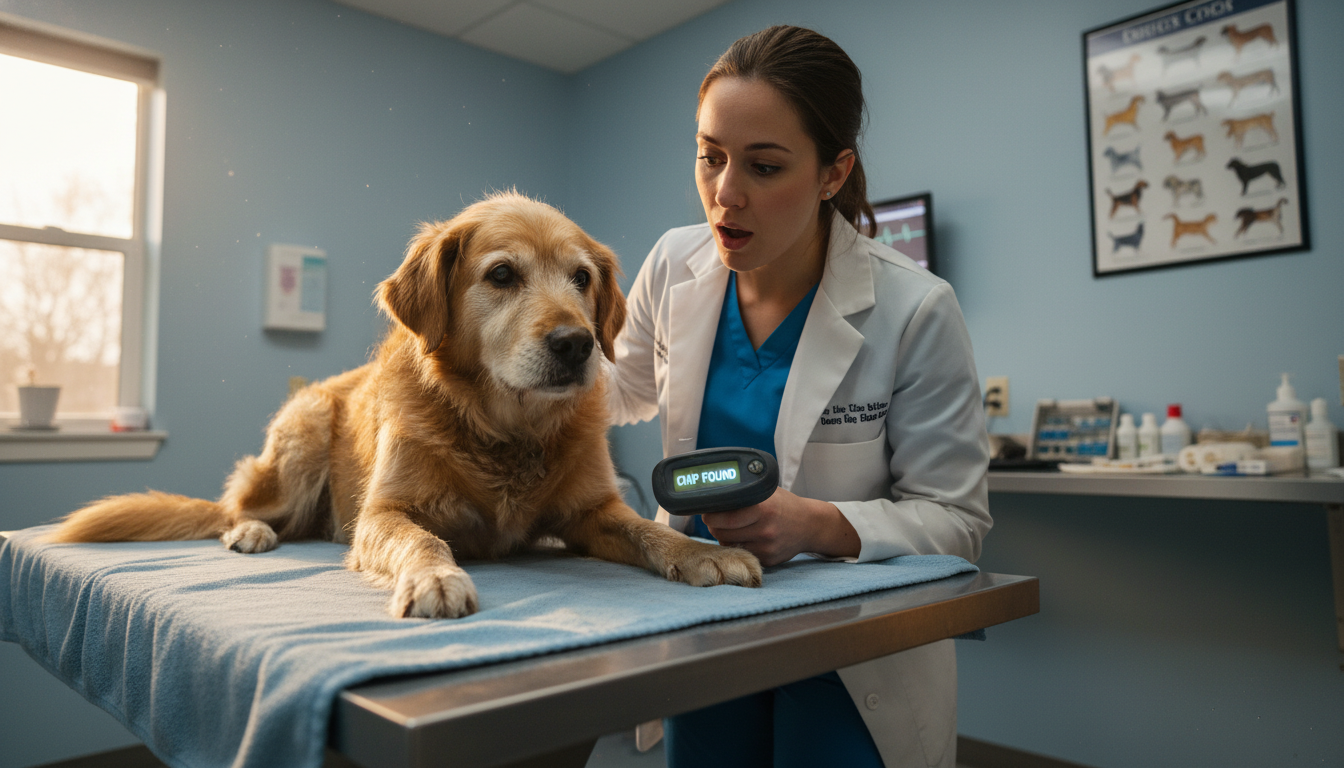
Acting on a hunch, Elena grabbed the universal scanner again. Instead of scanning the neck, she ran the device slowly down Barnaby’s left leg, hovering over the hard lump she had felt.
A high-pitched beep echoed through the exam room.
The screen lit up with a 15-digit identification number. The staff froze. The detail they almost missed was a microchip that had migrated inches away from the standard scanning zone. Had Elena not looked closer, Barnaby would have remained a nameless stray.
“It happens more often than people realize,” says Dr. Emily Weiss, a veterinary expert associated with the ASPCA. “Microchips are the only permanent form of identification, but they aren’t GPS devices. They rely on a scanner passing directly over them. If a chip migrates and staff only scan the neck, a beloved pet can easily be misidentified as a stray.”
The Phone Call That Changed Everything
Elena rushed to the computer database to look up the number. The registration information that popped up was shocking. The dog’s name wasn’t Barnaby. It was “Bailey.” And he wasn’t from the local area. He was registered to a family in Ohio—over 800 miles away.
Even more concerning was the status of the chip: Reported Stolen – 6 Years Ago.
With trembling hands, Elena dialed the phone number listed on the account, expecting it to be disconnected after so much time. To her surprise, it rang.
A woman answered. When Elena identified herself and asked if she knew a dog named Bailey, there was a long silence on the other end, followed by the sound of weeping. The woman, named Sarah, explained that Bailey had been taken from their backyard six years prior. They had posted flyers, contacted news outlets, and searched for years, but eventually, they had to accept he was gone. They never stopped hoping, but they never expected this call.
A Miraculous Reunion
The reunion that followed was nothing short of miraculous. Sarah and her husband drove through the night, arriving at the shelter the very next morning. The staff was worried that Bailey—now frail, blind in one eye, and much older—might not remember them. Six years is a lifetime for a dog.
Elena brought Bailey into the meet-and-greet yard. He walked with his head down, sniffing the grass, indifferent to the humans standing nearby. Then, Sarah spoke.
“Bailey? Is that my good boy?”
The transformation was instantaneous. The old dog’s head snapped up. His ears, previously drooping, perked forward. He let out a sharp bark and began to pull toward the voice. When he reached Sarah, he collapsed into her lap, burying his face in her neck, making the same whining sounds he used to make as a puppy. There wasn’t a dry eye among the shelter staff.
This heartwarming conclusion underscores the importance of microchipping your pets and keeping the registration current. It also highlights why thorough intake exams are critical.
The Importance of Looking Closer
Bailey’s story is a powerful reminder of the resilience of the human-animal bond. Despite the time and distance, the connection remained unbroken. However, it also serves as a warning about the limitations of technology and the necessity of human diligence.
According to statistics from the American Veterinary Medical Association (AVMA), stray dogs with microchips are more than 2.5 times more likely to be returned to their owners than those without. However, migration of the chip can occur, which is why veterinarians recommend scanning the entire body of a stray animal, not just the neck.
For Bailey, that extra few seconds of attention from a vet tech meant the difference between a lonely end in a shelter and a loving retirement in the home he was stolen from.
If you enjoyed this story of an incredible reunion, read more about extraordinary rescues that prove love knows no bounds.
What Happens Next
Today, Bailey is back in Ohio, sleeping on a orthopedic bed and getting the medical care he desperately needed. His fur has been groomed, his eyes treated, and he spends his days surrounded by the family that never forgot him.
The shelter staff who saved him have used his story to advocate for better scanning protocols. Because they looked closer, a “stray” became a beloved family member once again.