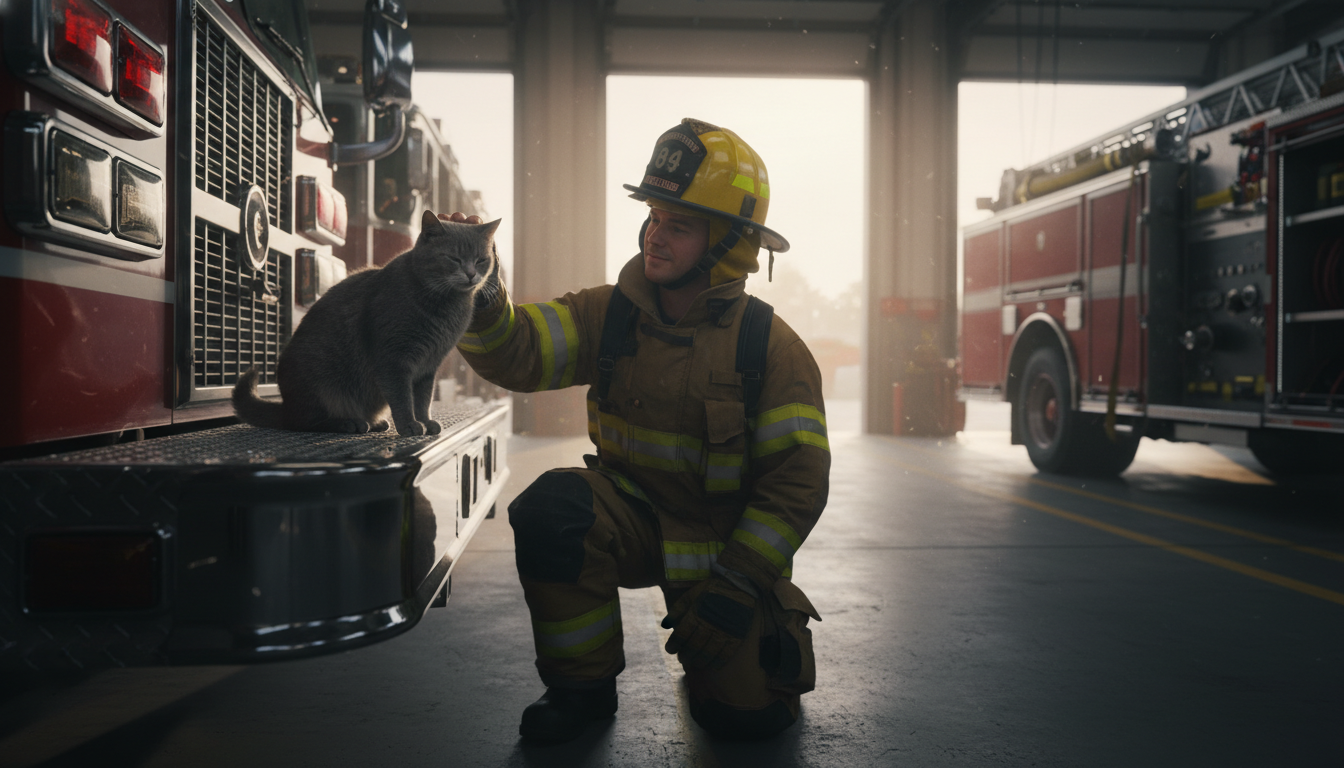
It began as a simple, unobtrusive habit. Every morning at exactly 6:45 AM, just as the overnight shift was brewing their final pot of coffee and the day crew was rolling into the parking lot, a scrawny, soot-colored cat would appear at the bay doors of Station 42. He didn’t beg, and he didn’t meow loudly. He simply sat on the concrete apron, wrapping his tail around his paws, waiting for the heavy metal doors to rise.
For the firefighters of Station 42, the arrival of the cat—whom they eventually named “Ash”—was initially just a curious footnote in their chaotic schedules. But over the course of three years, what started as a stray animal’s quest for a meal evolved into a profound emotional anchor for a group of people facing some of the most difficult moments of their lives. Ash’s daily routine didn’t just fill his stomach; it ended up filling a void in the station that no one had realized was there, sparking a conversation about mental health and the healing power of animals that rippled through the entire community.
The Routine That Started It All
According to station logs and interviews with the crew, Ash first appeared during a particularly harsh November cold snap. He was malnourished, wary of humans, and covered in burrs. Captain Mike Reynolds, a veteran of the department for over 20 years, was the first to notice the pattern.
“He was punctual, I’ll give him that,” Reynolds told local reporters in a retrospective on the station’s history. “You could set your watch by him. 6:45 AM. He’d sit there, wait for the door to go up, eat the bowl of kibble we started leaving out, and then he’d vanish into the woods behind the station until the next morning.”
For months, this was the extent of the relationship. It was transactional. The firefighters provided food; the cat provided a brief moment of amusement. However, as winter turned to spring, Ash’s behavior shifted. He stopped leaving after breakfast. Instead, he began venturing into the apparatus bay, finding warm spots on the hoods of the diesel engines or curling up on the gear racks.
The transition from stray to station fixture wasn’t immediate, but it was steady. The firefighters, known for their tough exteriors, found themselves softening around the small creature. It wasn’t uncommon to see a burly first responder, still covered in grime from a call, pausing to scratch Ash behind the ears before hitting the showers.
Sensing the Stress: An Unspoken Therapy
The true turning point in Ash’s role at the station came after a devastating residential fire in late 2019. The crew returned to the station exhausted, demoralized, and silent. The emotional toll of the job is often cited by organizations like the National Volunteer Fire Council as a primary driver of burnout and mental health struggles among first responders.
On that specific morning, Ash broke his usual routine. Instead of sleeping in the sun, he reportedly walked directly into the day room where the crew was debriefing. Witnesses say he hopped onto the lap of the firefighter who had been most affected by the call, purring loudly and refusing to move.
“It changed the atmosphere in the room instantly,” a crew member recalled. “We went from sitting in this heavy, oppressive silence to cracking half-smiles because this stubborn cat wouldn’t leave rookie Johnston alone. It forced us to take a breath. It grounded us.”
From that day forward, Ash seemed to designate himself as the station’s emotional support officer. He developed an uncanny ability to identify who was having a bad day. If the tones dropped for a difficult medical call, Ash would often be waiting by the bay doors when the truck returned, greeting the crew as they disembarked.
The Bond Between Humans and Animals
The science behind this bond is well-documented. Studies have shown that interacting with animals can lower cortisol levels and blood pressure, providing physiological relief from stress. For the firefighters at Station 42, Ash became a living example of this phenomenon. He wasn’t just a mascot; he was a colleague.
As the bond deepened, the station formally adopted him. They pooled money for his veterinary care, vaccinations, and a high-end climbing tower that was placed in the corner of the day room. Much like the stories of rescue dogs alerting owners to danger, Ash was saving his humans in a different way—protecting them from the silent accumulation of trauma.
Local veterinarian Dr. Sarah Jenkins, who treated Ash, noted that the cat’s demeanor was unique. “He was a survivor,” she said. “Strays often retain a level of independence, but Ash clearly understood that his safety was tied to these people. In return, he offered them a consistency that their job rarely allowed. He was the one thing in their day that was predictable and safe.”
The Impact on the Community
Ash’s story eventually leaked out of the firehouse and into the wider community. A photo of him sleeping inside a firefighter’s helmet went viral on local social media pages, prompting an outpouring of support. Community members began dropping off treats and toys, but more importantly, they began asking questions about the firefighters’ well-being.
The “Ash Effect,” as it came to be known, allowed the department to open up a dialogue about mental health in emergency services. The station used Ash’s popularity to launch a “Station Pets” initiative, partnering with a local animal shelter to foster difficult-to-place cats. The program highlighted how animals, often overlooked or discarded, could serve vital roles in high-stress environments.
“We realized that Ash wasn’t just helping us; he was helping the public see us as human beings,” Captain Reynolds explained. “People often see the uniform and the truck. They don’t see the person carrying the weight of what they witnessed. Ash bridged that gap.”
A Legacy of Comfort
While Ash is now an older cat, moving a bit slower and spending more time napping than greeting the trucks, his daily routine remains the heartbeat of the station. He still eats at 6:45 AM, and he still inspects the boots of the incoming crew.
His presence serves as a daily reminder that sometimes, the most significant changes come from the smallest, quietest habits. What began as a stray cat seeking warmth became a foundational element of a fire station’s culture, proving that extraordinary bonds can form in the most unexpected places.
Today, other stations in the district have adopted similar programs, citing Station 42’s success. It stands as a testament to the fact that while firefighters are tasked with saving lives, sometimes they are the ones who need a little saving—and sometimes, that savior arrives on four paws, looking for breakfast.