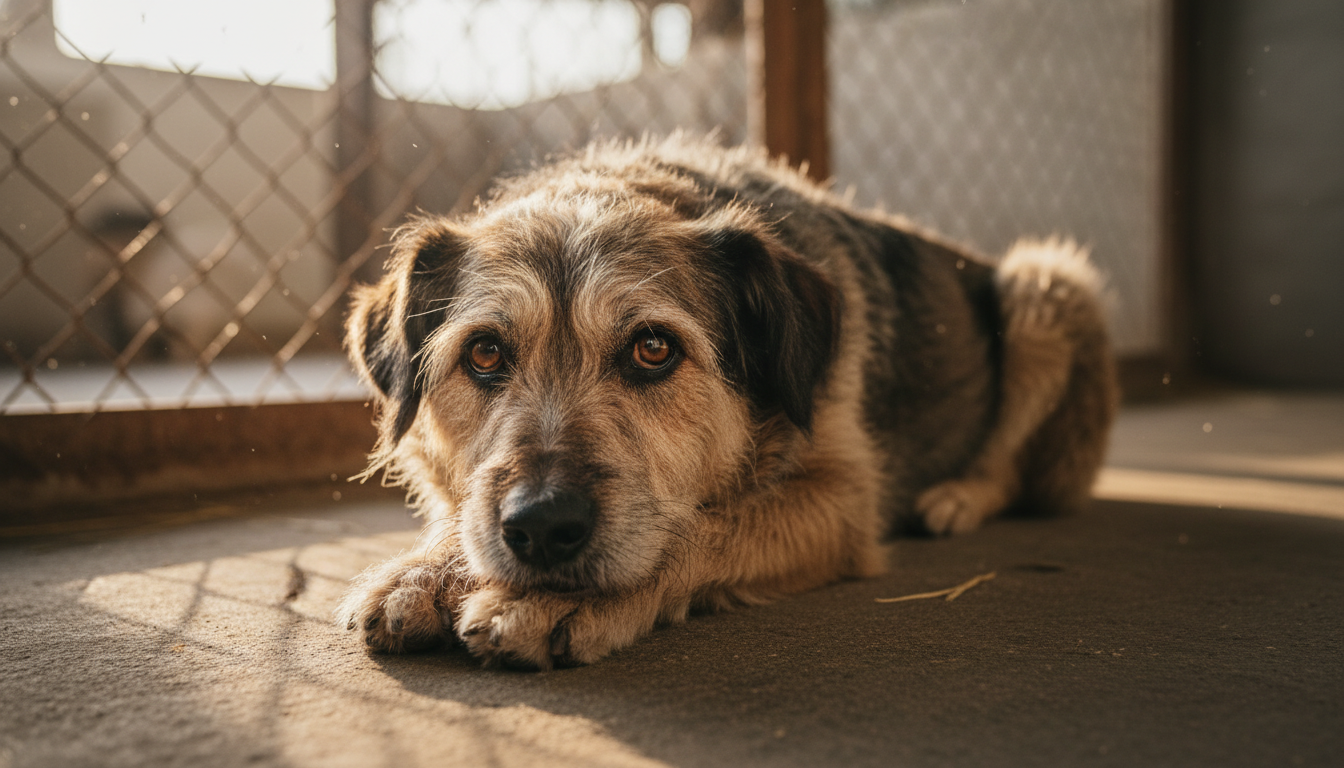
In the high-volume world of animal control, visibility is often the only difference between a second chance and a tragic statistic. For one dog, a senior mix named Bear, invisibility was becoming a death sentence. Surrendered to a busy municipal facility after his elderly owner passed away, Bear did what many confused and grieving animals do: he shut down.
It is a phenomenon well-documented by ethologists and rescue professionals. According to the ASPCA, the transition from a home environment to a kennel can cause profound psychological stress, leading to behavior that potential adopters often mistake for aggression or disinterest. Bear didn’t bark at passersby. He didn’t wag his tail. For three weeks, he simply sat in the back corner of run number 42, staring at the cinderblock wall.
With the shelter reaching critical capacity, Bear’s time was running out. He was labeled as “rescue only” due to his depressive state, a designation that often precedes euthanasia unless a dedicated foster can be found immediately. That was until a volunteer, walking through the rows with a smartphone, decided to pause. She didn’t try to force Bear to look happy. Instead, she captured the raw reality of his grief. That single, unpolished shelter dog photo would go on to stop the scroll of thousands, proving that sometimes, a picture isn’t just worth a thousand words—it’s worth a life.
The Silent Crisis of Owner Surrenders
Bear’s story is not unique, which is perhaps why it resonated so deeply with the online community. Shelter staff frequently report that owner-surrendered dogs, particularly seniors, struggle the most with kennel life. Unlike strays who may be accustomed to the unpredictability of the streets, dogs like Bear have known stability their entire lives. When that stability is shattered, the decline can be rapid.
According to intake records shared by rescue advocates involved in his case, Bear was an 8-year-old Labrador-Shepherd mix who had lived with one person since puppyhood. When his human died, no next of kin stepped forward to claim him. He arrived at the shelter with his favorite squeaky hedgehog toy, but within days, the toy lay untouched in the sawdust.
Staff noted in his file that he was “shutting down,” a clinical observation that carries heavy weight in animal welfare. It means the dog is ceasing to interact with the environment. They stop eating, they stop making eye contact, and their immune systems often crash due to cortisol spikes. Bear was fading, and in a facility taking in dozens of animals a day, fading dogs are often overlooked by families looking for a bubbly puppy.
The Image That Changed Everything
The turning point came on a Tuesday afternoon, just 24 hours before Bear was scheduled for a final evaluation. A volunteer photographer, part of a local network dedicated to marketing at-risk dogs, stopped at his kennel. She lowered her camera through the chain-link fence.
In the photograph, Bear wasn’t begging. He was resting his heavy head on his paws, his eyes cast downward in a look of profound resignation. The lighting was harsh, illuminating the gray on his muzzle and the sterile concrete floor. It wasn’t a “cute” photo. It was a devastatingly honest documentation of heartbreak.
The volunteer posted the image to a regional rescue coordination group with a simple caption: “This is what a broken heart looks like. Bear has given up. We have until tomorrow to show him he matters.”
The algorithm took over from there. The post was shared hundreds of times within the hour. It wasn’t the quality of the photography that went viral; it was the emotion. Users commented that they could feel his pain through the screen. The shelter dog photo became a rallying cry, illustrating the stark reality that animals experience grief just as acutely as humans do.
A Community Mobilizes
The power of social media in animal rescue is a double-edged sword, often bringing noise without solutions. However, in Bear’s case, the signal cut through. A rescue organization two states away, specializing in senior dogs, was tagged in the post by multiple supporters.
Rescue coordinators worked through the night. Securing a tag for a dog in a high-kill facility involves complex logistics: verifying the rescue’s credentials, arranging temporary boarding if transport isn’t immediate, and securing funds for veterinary care. By Wednesday morning—the day Bear’s time was theoretically up—the shelter received the confirmation email. Bear was safe.
But the story didn’t end with a signature. The photo had caught the eye of Sarah, a graphic designer living six hours away. She hadn’t been looking for a dog, but as she later told rescue volunteers, she couldn’t get Bear’s face out of her mind. She saw a reflection of her own grief, having lost her father earlier that year.
For more on how rescue networks operate across state lines, read our feature on the incredible journey of transport dogs.
The Freedom Ride and Decompression
When Sarah arrived to pick Bear up from the rescue partner, the transformation wasn’t instant. Real life is rarely a Disney movie in the first few minutes. Bear was hesitant, stiff, and smelled of the shelter. He didn’t jump into the car; he had to be lifted.
The “Rule of Three” is a common guideline in animal rescue: three days to decompress, three weeks to learn the routine, and three months to feel at home. Bear followed this timeline almost exactly. For the first few days, he slept for 18 hours at a time, exhausted from the chronic stress of the shelter environment.
It was on the fourth day that the breakthrough happened. Sarah captured a new photo, one that would serve as the bookend to the viral image that saved him. In this new picture, Bear was sleeping on a plush orthopedic bed, belly up—a position of vulnerability and trust. His gray muzzle was relaxed, and a new toy, identical to the hedgehog he lost, was tucked between his paws.
The Legacy of One Photo
Bear’s story serves as a potent reminder of the importance of advocacy. Without that specific shelter dog photo, taken by a volunteer who chose not to walk past the “depressed” dog, Bear would likely have been another unspoken casualty of the system.
Today, Bear (now renamed “Barnaby” to mark his new life) has become a local ambassador for senior adoption. Sarah uses her platform to share his journey, highlighting that “shut down” dogs are often the most loyal companions once they feel safe.
His recovery highlights the resilience of the canine spirit. Despite losing everything he knew, and facing the terrifying isolation of the kennel, he was able to bond again. It required patience, but mostly, it required visibility.
For those inspired by Barnaby’s journey, consider volunteering at your local shelter. You don’t need to be a veterinarian or a dog trainer to make a difference. sometimes, all you need is a smartphone and a moment of compassion to change a destiny. If you are considering adding a member to your family, check out our guide on why adopting a senior dog is the ultimate act of love.
The volunteer who took that final shelter photo didn’t just capture an image; she captured a soul screaming for help in silence. And thankfully, the world listened.