In the high-decibel, emotionally charged environment of an animal shelter, silence is often more telling than noise. For shelter staff, the daily intake process is a rigorous routine of medical checks, behavioral assessments, and paperwork. But every so often, a specific file crosses a desk that brings the bustling operation to a standstill. This is the story of a senior dog, a surrender form, and a single handwritten line that revealed a lifetime of love left behind.
The Reality of Owner Surrenders
When a dog arrives at a municipal shelter, they are often stripped of their history. They become a number, a breed mix, and an estimated age. However, in cases of owner surrender, there is a paper trail. These forms are usually filled out in moments of desperation—by families losing their homes, elderly owners moving into assisted living, or relatives handling the estate of a deceased loved one.
According to data from the ASPCA, approximately 3.1 million dogs enter U.S. animal shelters nationwide every year. While many are strays, a significant portion are surrenders. For shelter employees, reading the “reason for surrender” and the “personality profile” is a necessary, albeit heartbreaking, part of the job. It is here, in the cramped handwriting of a stranger, that the dog’s true identity is often hidden.
The Arrival of Barnaby
It was a Tuesday afternoon when a 12-year-old mixed breed, who we will refer to as Barnaby, was brought into a shelter in the Pacific Northwest. Barnaby was not a difficult dog. He didn’t bark, he didn’t pull on the leash, and he didn’t show signs of aggression. He simply trembled. His eyes were clouded with the beginnings of cataracts, and his muzzle was frosted white with age.
The intake staff processed him with the gentle efficiency reserved for seniors. Older dogs are notoriously difficult to place; they often shut down in the kennel environment, confused by the concrete floors and the cacophony of barking neighbors. Barnaby was placed in a quiet corner run, curled tightly into a ball on his cot, facing the back wall.
The Note That Changed Everything
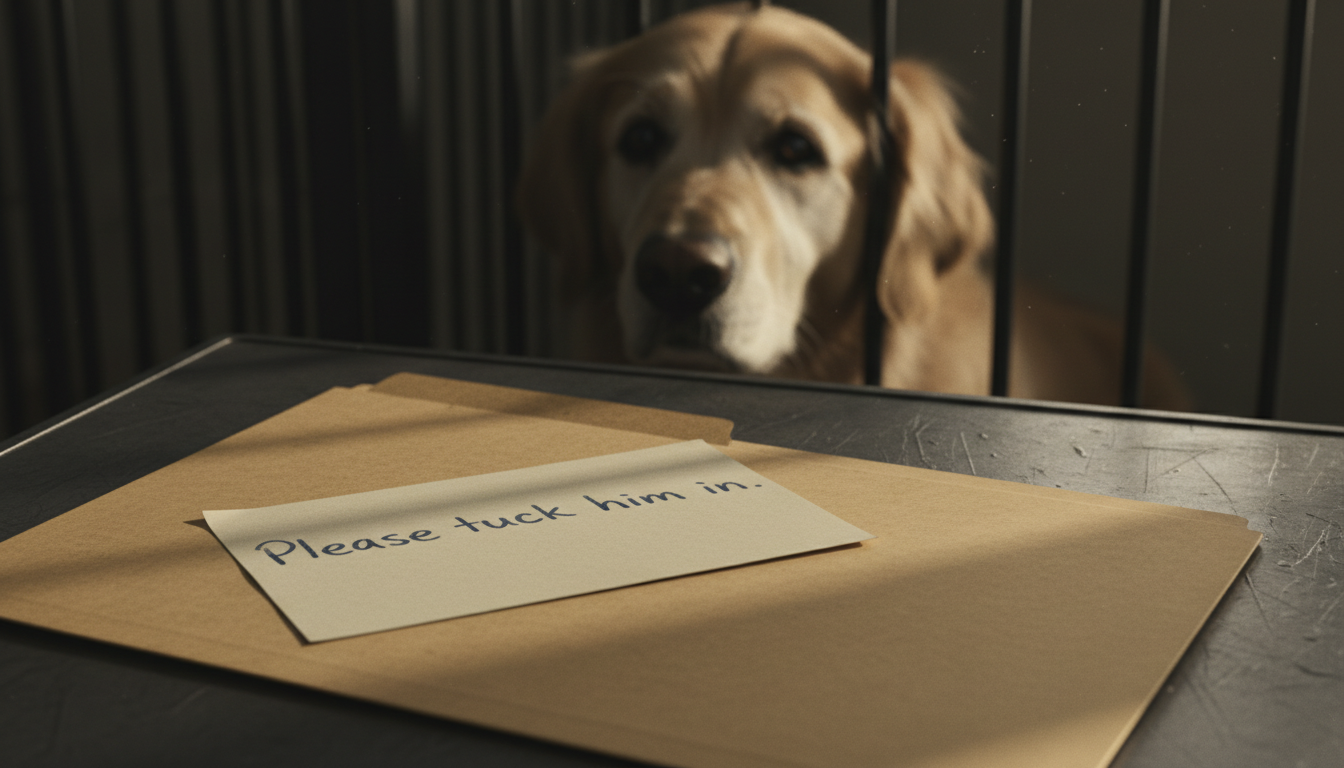
It wasn’t until the kennel manager sat down to review Barnaby’s intake paperwork that the gravity of his situation became clear. The form was standard—medical history, diet, bite history (none). But at the bottom of the page, under the section asking for “Special Habits or Needs,” the previous owner had written a single, shaky sentence:
“He cannot sleep unless you cover him with his blue blanket and tell him he is a good boy.”
The worker froze. That single sentence, written in what appeared to be the trembling hand of an elderly person, painted an entire picture of Barnaby’s life. He wasn’t just a dog; he was a companion who had been tucked in every night. He was part of a ritual. The realization that Barnaby was likely waiting for that blue blanket and that specific voice was devastating.
Staff members reported that upon checking Barnaby’s belongings, they found the blue blanket in his surrender bag. It was worn, smelling faintly of laundry detergent and an old house. When a staff member approached Barnaby’s kennel that evening, blanket in hand, the change was immediate. The senior dog, who had refused to look at anyone all day, lifted his head.
The Impact of the “Heartbreaking Surrender Note”
Stories like Barnaby’s highlight a hidden crisis in animal welfare: the separation of bonded pairs—human and animal—due to circumstances beyond their control. Veterinary professionals often note that senior dogs suffer from depression when separated from their owners, manifesting as lethargy and refusal to eat.
The shelter worker took a photo of the note (redacted for privacy) and the sleeping dog, sharing it on the shelter’s social media page. The post was not meant to shame the previous owner—who clearly loved the dog deeply—but to find a new family willing to honor that specific routine. The caption was simple: “We are tucking him in tonight, but he needs a home where this promise can be kept.”
The response was instantaneous. The story of the senior dog who needed to be tucked in went viral within the community. It struck a chord because it humanized the animal in a way that statistics never could. It reminded the public that every dog in a kennel run has a history, a personality, and specific emotional needs.
A Community Steps Up
Within 24 hours, the shelter received dozens of applications. However, the staff was meticulous. They weren’t looking for just any home; they were looking for a retirement home. They needed someone who understood that adopting a senior dog is often more about hospice care and emotional support than long hikes and playtime.
A couple in their 60s, who had recently lost their own Golden Retriever, came to meet Barnaby. They brought a calmness that the shelter environment lacked. When they entered the meet-and-greet room, Barnaby didn’t jump or play. He simply walked over and leaned his weight against the woman’s leg—a classic sign of a dog seeking security.
The shelter staff watched as the woman knelt, stroked his head, and spoke softly to him. It was a perfect match. But the adoption wasn’t finalized until the staff handed over the blue blanket and explained the instruction on the file.
The Happy Ending
Barnaby left the shelter three days after he arrived. He did not leave as a stray or a statistic, but as a cherished family member. Follow-up reports from his new family confirmed that the tradition continued. Every night, Barnaby was covered with his blue blanket (and eventually a newer, softer one) and told he was a good boy before the lights went out.
This story serves as a powerful reminder of the bonds we share with our animals. For shelter workers, reading a heartbreaking surrender note is a daily emotional burden, but it is also a roadmap. It guides them in understanding the animal’s past to secure their future.
While we may never know the full story of the person who wrote that note, their plea was heard. They ensured that even in their absence, their beloved companion would feel safe, loved, and remembered.