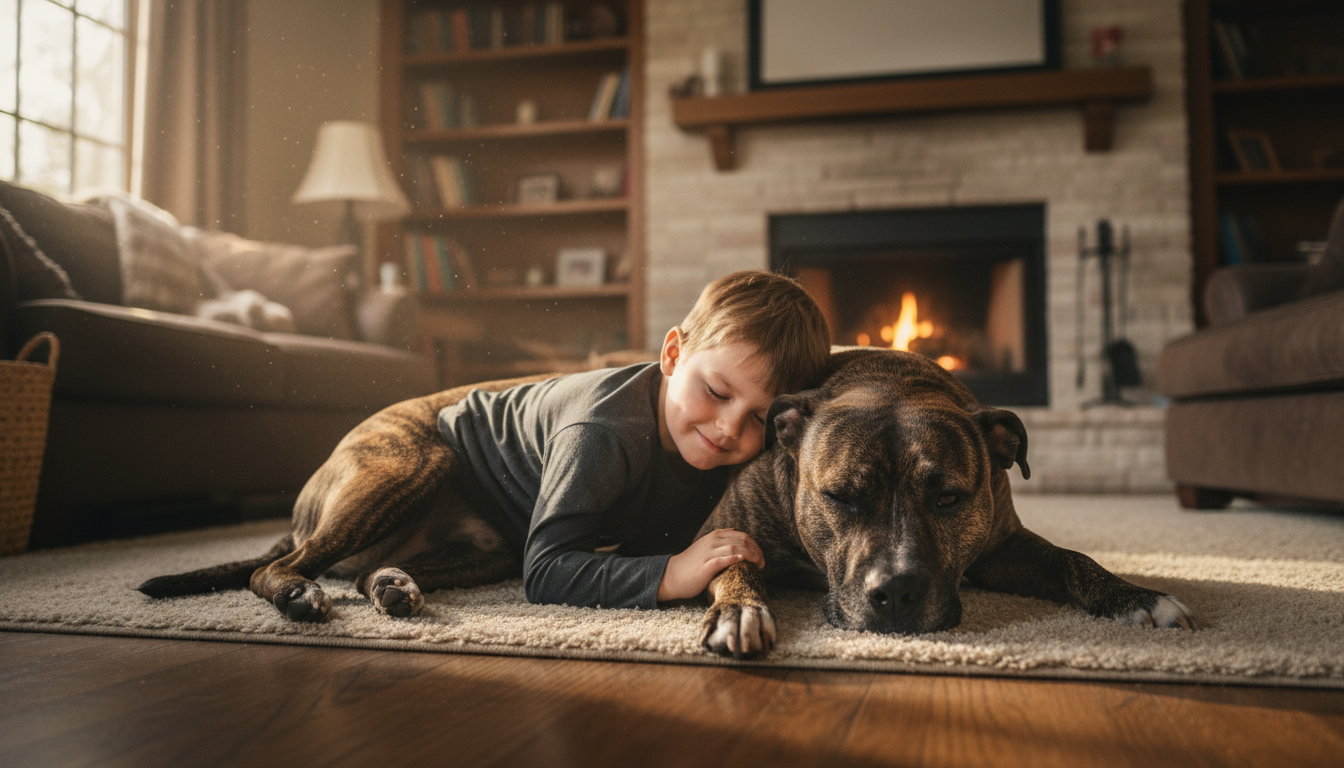
For nearly eight years, the Hickey household in Johns Creek, Georgia, was defined by a heavy, pervasive silence. It wasn’t that the house was empty—far from it. It was full of love, concern, and the quiet struggle of a young boy named Jonny.
Jonny, diagnosed with autism, lived in a world largely sealed off from those around him. While he could physically speak, he rarely did. Social interactions were a source of immense anxiety, causing him to retreat into a shell where he felt safe, but isolated. His mother, Linda Hickey, described the heartbreak of watching her son struggle to connect, fearing he would never experience the simple joys of childhood friendship or uninhibited expression.
But the trajectory of Jonny’s life—and his voice—changed forever the day a emaciated Staffordshire Terrier mix arrived at a local shelter, clinging to life by a thread.
A Miracle in the Making
The story of Jonny’s breakthrough begins not with a therapy session, but with a tragedy turned miracle. A few months prior to Jonny’s transformation, a puppy was brought into the DeKalb County Animal Services. The dog had collapsed in a yard, severely emaciated and suffering from egregious neglect. Shelter staff estimated she weighed only four pounds when she should have weighed at least ten. She was given a less than one percent chance of survival.
Rescue workers named her Xena, after the Warrior Princess, hoping the moniker would grant her the strength she desperately needed. Against all medical odds, Xena fought back. Her recovery was slow and painful, documented by the rescue community who rallied around her. It was through social media that Linda Hickey first saw Xena.
Linda, who had been following the dog’s harrowing journey online, felt an inexplicable pull. She decided to attend a fundraising event where Xena would be making an appearance. She brought Jonny along, though she had no expectations of how he would react. Typically, crowds and sensory overload caused Jonny to shut down completely.
The Instant Connection
What happened next stunned everyone present. When the skinny, recovering puppy and the silent, withdrawn boy met, the atmosphere in the room shifted. According to witnesses and later recounts by Linda, Xena immediately walked over to Jonny. She didn’t jump or bark; she simply leaned into him.
Jonny, who usually recoiled from physical touch, didn’t pull away. He began to stroke her scars. In that moment, a silent understanding passed between the two survivors. One was healing from physical trauma, the other from emotional isolation.
Linda Hickey noted in interviews with news outlets like the TODAY show that Xena seemed to sense Jonny’s vulnerability. The family decided to adopt Xena, bringing the warrior puppy home. It was a gamble that would pay off in ways no doctor could have predicted.
Breaking the Silence
The transformation in the household was almost immediate. Xena, grateful for a warm home, became Jonny’s shadow. She rode in the car with him to school and sat by his side while he did homework. The pressure to perform socially, which often paralyzed Jonny, didn’t exist with Xena. She demanded nothing but presence.
Gradually, the silence began to fracture. It started with whispers. Jonny would talk to Xena, telling her about his day or whispering assurances that she was a “good girl.” The dog listened without judgment, her tail wagging a steady rhythm of acceptance.
“He is the happiest child that I’ve ever seen him be in eight years,” Linda Hickey told reporters following the adoption. The boy who wouldn’t speak began chatting with his parents about the dog. His vocabulary expanded, his confidence surged, and his anxiety levels dropped significantly.
The Science Behind the Bond
While Jonny and Xena’s story feels like magic, there is hard science supporting this phenomenon. Research from the Human Animal Bond Research Institute (HABRI) indicates that interaction with pets can significantly lower cortisol levels (stress hormones) and increase oxytocin production in children with autism. This biological shift can create a neurological environment more conducive to communication and social interaction.
Veterinary behaviorists have long noted that dogs communicate primarily through body language, which can be less overwhelming for autistic children who may struggle with the nuances of human verbal communication and eye contact. For Jonny, Xena was a bridge to the human world—a translator who taught him that connection could be safe.
Impact on the Community
The duo didn’t just change their own lives; they became advocates for animal rescue and autism awareness. Jonny and Xena were named the ASPCA’s “Dog of the Year,” a title that brought them to national stages. The boy who once shrank from crowds stood tall beside his dog in front of cameras and audiences.
In a profound moment captured on video, Jonny grabbed a microphone at an awards ceremony. The crowd held its breath. The boy who once wouldn’t speak declared loudly and clearly, “I believe that Xena was hurt and neglected so that she could be a message to the world to be kind to animals.”
This statement wasn’t just a sentence; it was a testament to the power of the human-animal bond. It highlighted how rescue animals often rescue their humans in return. You can read more about how rescue dogs heal human hearts in our previous coverage of emotional support animals.
A Legacy of Love
The story of Jonny and Xena serves as a powerful reminder that “broken” beings often fit together to make a whole. Xena’s physical scars healed, covered by a healthy coat, just as Jonny’s social barriers melted away.
Their journey underscores the importance of adopting shelter animals. While Xena was initially seen as a hopeless case, she possessed the exact empathy and resilience needed to unlock a young boy’s potential. It challenges the stigma often associated with shelter dogs, particularly breeds like pit bull mixes, proving that their capacity for love is boundless.
Today, the legacy of that initial meeting continues to inspire families facing similar struggles. It reminds us that sometimes, when human interventions reach their limit, a wet nose and a listening ear can accomplish the impossible.
For those considering bringing a pet into a home with neurodiverse family members, experts suggest working with local shelters to find an animal with the right temperament. As Jonny’s story proves, the perfect match might just be waiting behind a kennel door.
If you enjoyed this story of resilience, you might also like our feature on senior dogs finding a new lease on life, proving it is never too late for a second chance.