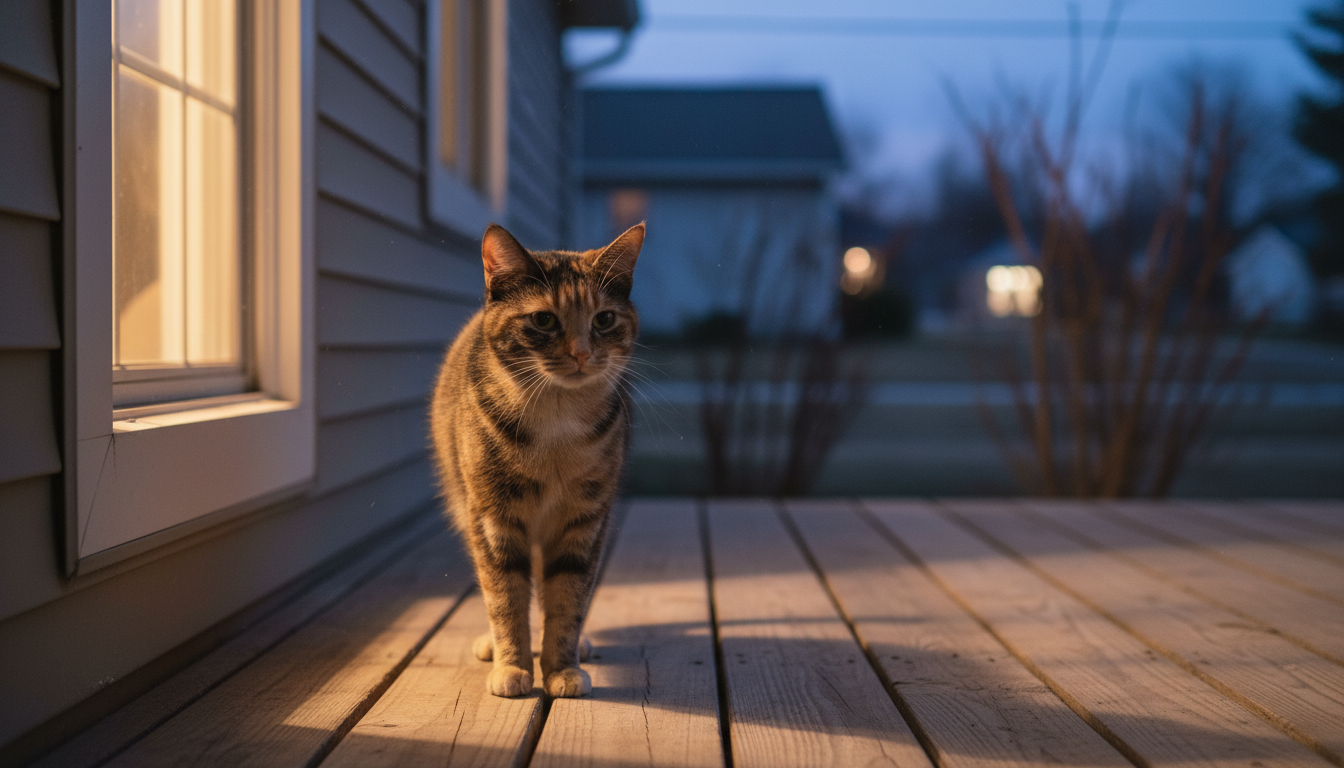
It is a nightmare scenario for any pet owner: a family vacation, a sudden noise, a door left ajar, and a beloved companion vanishes into an unfamiliar city, hundreds of miles from home. For Jacob and Bonnie Richter, this nightmare became a reality when their tortoiseshell cat, Holly, bolted during a trip to Daytona Beach, Florida. They spent days searching, distributing flyers, and calling local shelters, but eventually, heartbroken, they had to return to West Palm Beach without her.
What happened over the next two months remains one of the most baffling and extraordinary mysteries in the world of animal behavior. Sixty-two days after she disappeared, Holly was found—not in Daytona Beach, but just a mile from her original home, having apparently walked nearly 200 miles along the Florida coast. This cat traveled 200 miles on paws that were rubbed raw, navigating highways, bridges, and wild terrain to find the one door she knew.
This is the true story of an impossible journey, the biological mystery of the feline homing instinct, and the unbreakable bond that guided a weary traveler back to the family she loved.
The Moment Everything Changed
The incident began innocuously enough at an RV park in Daytona Beach. Holly, strictly an indoor cat described by her owners as timid and unlikely to wander, was startled by a burst of fireworks. In the chaos, she bolted from the family’s recreational vehicle and disappeared into the unfamiliar surroundings.
According to reports from local news outlets at the time, the Richters did everything right. They notified local agencies, alerted the campground staff, and searched the area extensively. But as days turned into weeks, the hope of finding Holly dwindled. The distance between Daytona Beach and West Palm Beach is approximately 190 to 200 miles—a three-hour drive by car, but an insurmountable odyssey for a small, four-year-old cat with no outdoor survival skills.
For two months, the family grieved, assuming their beloved pet had been adopted by a stranger or had succumbed to the dangers of the outdoors. They had no way of knowing that Holly was moving, day after day, driven by a singular, inexplicable compulsion to return south.
A Shocking Discovery in a Backyard
Two months later, in a neighborhood near the Richters’ home in West Palm Beach, a woman named Barb Mazzola noticed a cat in her backyard. The animal was in a pitiful state—emaciated, weak, and barely able to stand. Mazzola, an animal lover, approached the creature gently, offering food and water.
The cat was so weak she could not vocalize. Her paws were bleeding, her claws worn down to nothing, and her fur was matted and dirty. Recognizing that this was not a feral stray but a desperate animal in need of help, Mazzola took the cat to a local veterinarian. It was there that the routine procedure of scanning for a microchip turned a sad rescue into a miraculous reunion.
The microchip data confirmed the impossible: this was Holly. The staff contacted the Richters, who were initially in disbelief. When they arrived at the clinic, the emotional weight of the moment was palpable. Despite having lost half her body weight, Holly recognized her family immediately.
The Physical Toll of the Journey
While the reunion was joyous, the reality of what Holly endured was sobering. Veterinary professionals who examined her noted that her condition was consistent with a long-distance trek on hard surfaces.
According to Dr. Hope Yanofsky, a veterinarian who treated Holly, the cat’s hind paws were particularly damaged, with the pads worn raw and the claws ground down to the quick. This physical evidence suggested that Holly had not hitched a ride—a common theory in long-distance pet returns—but had walked the entire distance herself.
To travel from Daytona to West Palm Beach, Holly would have had to navigate a complex hazardous landscape. The route implies crossing Interstate 95, traversing multiple waterways, avoiding predators like coyotes and alligators, and finding food and water in an environment she had never experienced. The sheer caloric expenditure required for such a journey explained her severe emaciation.
The Mystery of the “Homing Instinct”
Holly’s story reignited a debate among animal behaviorists regarding the “homing instinct,” often referred to as psi-trailing. How does a cat, with no map and no previous knowledge of the route, orient itself toward home over such a vast distance?
According to experts at the Humane Society and other animal behavior institutes, cats may rely on a combination of sensory inputs that humans cannot perceive.
- Magnetic Fields: Some scientists theorize that cats, like birds and sea turtles, possess a sensitivity to the Earth’s magnetic fields, allowing them to function like a living compass.
- Olfactory Cues: A cat’s sense of smell is fourteen times stronger than a human’s. While 200 miles is too far to smell home directly, they may be able to smell familiar regional vegetation or air currents.
- Visual Mapping: While less likely over 200 miles of unseen terrain, cats are acute observers of their environment.
Despite these theories, Dr. Marc Bekoff, a professor of ecology and evolutionary biology, noted in interviews regarding Holly’s case that science still cannot fully explain how an indoor cat could achieve such a navigational feat. It remains one of nature’s most heartwarming anomalies.
Impact on the People and Community
The story of the cat who traveled 200 miles resonated far beyond West Palm Beach. It became a viral sensation, but more importantly, it served as a powerful testament to the importance of microchipping. Without that tiny chip, Holly would have likely been treated as a stray and perhaps never returned to the Richters, regardless of how far she walked.
For the local community, Holly became a symbol of resilience. Her recovery was slow; she required weeks of rest, specialized diets to regain her weight safely, and care for her injured paws. But she did recover, returning to her life as a pampered indoor cat—though her days of traveling were certainly over.
This narrative also serves as a critical reminder for pet owners traveling with animals. Experts recommend using secure carriers, harnesses, and ensuring all identification tags and microchip information are up to date before leaving home. Preparation is key to preventing heartbreak.
A Bond That Knows No Distance
In the end, the science of how Holly found her way back matters less than the emotional truth of why she did it. Whether guided by magnetic fields or sheer willpower, her journey was driven by a need for safety, familiarity, and love.
When we look at our pets dozing on the sofa, it is easy to underestimate them. We see them as dependent and domestic. But stories like Holly’s remind us that beneath that soft fur lies a fierce, ancestral survival instinct and a loyalty that can traverse highways, cities, and hundreds of miles of asphalt just to find the right door again.
Holly’s trek is more than a survival story; it is a love story, written in paw prints across the state of Florida, proving that for some animals, no distance is too great to get back to where they belong.