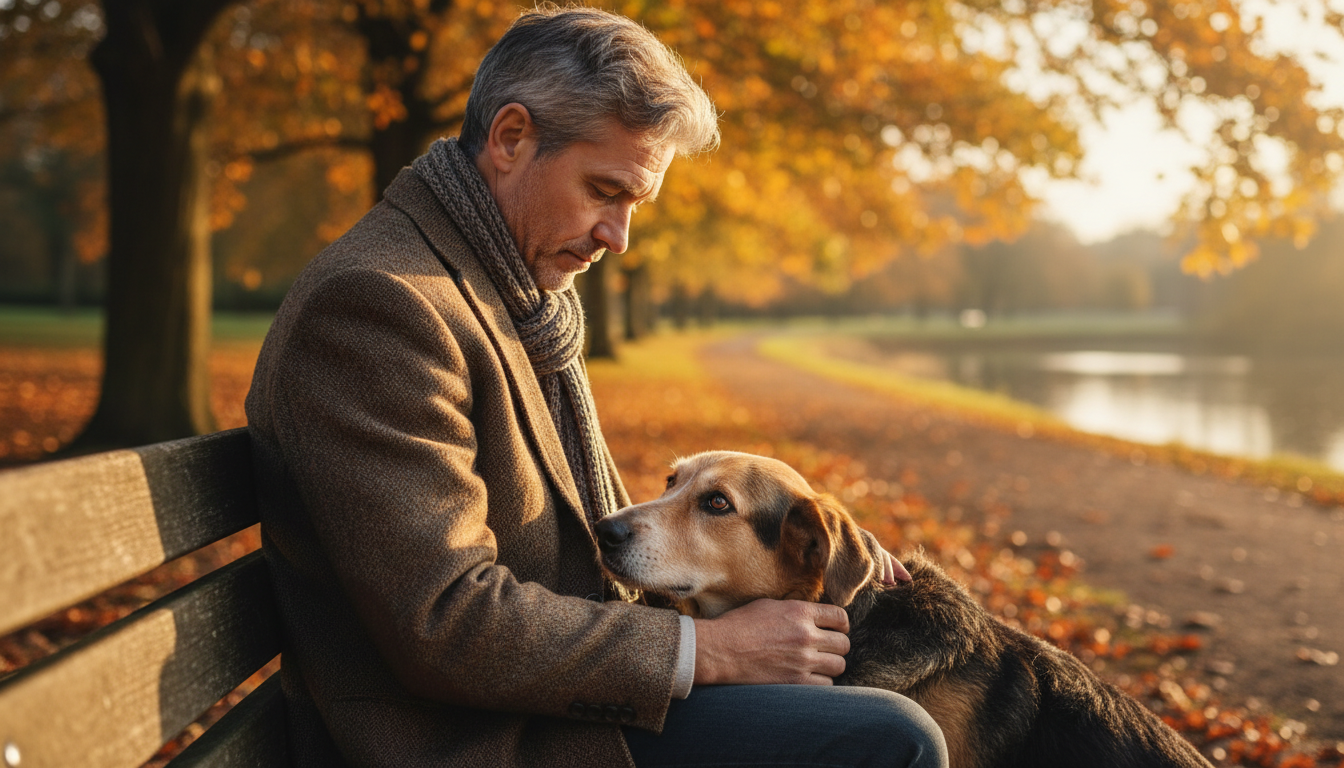
The silence in the hallway was the loudest thing Mark had ever heard. For forty years, that hallway had echoed with the sounds of a shared life: the click of heels, the hum of a vacuum, the laughter of his wife, Sarah. When Sarah passed away suddenly last winter, the silence rushed in like a flood, threatening to drown everything that remained. But in the corner of the living room, a pair of brown eyes watched, refusing to let Mark go under.
Those eyes belonged to Buster, a four-year-old rescue mix with a coat the color of burnt toast and a tail that seemed to operate independently of his body. Mark and Sarah had adopted him just two years prior, a scruffy, anxious thing found wandering near a highway. They had saved him. Now, in the dark quiet of a grieving home, it was Buster’s turn to return the favor.
This is not just a story about a man and his dog. It is a testament to the profound, scientifically documented power of the human-animal bond to bridge the gaps that words cannot reach. When grief rendered Mark speechless and isolated, a dog helped his owner through grief in ways that friends, family, and therapy initially could not.
The Weight of Silence
In the weeks following the funeral, Mark, a retired schoolteacher, found himself retreating from the world. The casseroles piled up in the freezer; the phone calls went to voicemail. Grief, according to psychologists, is not merely an emotional state but a physiological one. It disrupts sleep, spikes cortisol levels, and depletes the brain’s feel-good chemicals. Mark was in the thick of it, drifting through his days like a ghost in his own home.
However, Buster did not understand funerals. He did not understand depression. He only understood routine, and he understood his pack. According to the research regarding animal emotions, dogs are highly attuned to human emotional states, capable of smelling changes in hormones and sensing subtle shifts in body language.
“I wouldn’t get out of bed,” Mark later recounted to shelter staff during a follow-up visit. “I didn’t see the point. But Buster would come in, rest his chin on the mattress, and let out this long, impatient sigh. He wouldn’t leave. He’d nudge my hand until I touched him. He made it impossible to ignore the living world.”
The Science of the Nudge
The interaction Mark described is what experts call “contact comfort.” When a dog leans against a grieving owner or nudges their hand, it triggers a release of oxytocin—the “love hormone”—in both the human and the animal. This biological reaction lowers blood pressure and reduces anxiety.
But Buster’s intervention went beyond chemistry; it was about necessity. A dog must be walked. A dog must be fed. In the depths of bereavement, when self-care feels like an insurmountable mountain, the care of another living being becomes a lifeline. Buster’s physical needs forced Mark to stand up, put on his coat, and open the front door.
Dr. Alan Beck, director of the Center for the Human-Animal Bond at Purdue University, has noted in various studies that the responsibility of pet ownership provides a sense of purpose that is crucial during life transitions. For Mark, that purpose was simple: Buster needed to go to the park.
Walking Back Into the World
The first few walks were mechanical. Mark kept his head down, avoiding eye contact with neighbors who might offer pitying smiles. Buster, however, was a social lubricant. He was a dog who greeted the world with a full-body wiggle.
One chilly Tuesday morning, a pivotal moment occurred at the local dog park. Buster began wrestling with a Golden Retriever, tangling their leashes. The owner of the other dog, a woman named Clara, laughed and apologized. As they untangled the lines, Clara noticed the heaviness in Mark’s demeanor.
“He’s a rescue, right?” she asked, scratching Buster behind the ears. “They have a way of saving us, don’t they?”
That simple question cracked the dam. Mark found himself talking—not about the weather, but about Sarah, about the emptiness of the house, and about how Buster was the only reason he was standing outside in the cold. It was his first real conversation in three months.
This phenomenon is common among pet owners. Animals provide a neutral ground for connection. Stories of rescue dogs often highlight how these animals force their humans into social situations, breaking the dangerous cycle of isolation that often accompanies deep grief.
An Intuitive Companion
While the walks reconnected Mark to the community, the nights were still the hardest. This is where the story of how a dog helped his owner through grief becomes truly intimate. Dogs are crepuscular by nature, often active at dawn and dusk, but Buster seemed to adapt his rhythm to Mark’s insomnia.
On the nights when the grief was a physical pain in his chest, Mark would sit in his armchair in the dark. Without fail, Buster would leave his designated bed, trot over, and curl up on Mark’s feet. He offered no advice. He didn’t say, “It gets better.” He simply offered his presence.
“He knew,” Mark said. “There is no other way to explain it. If I was crying, he would press his head against my knee and just hold it there. He was an anchor.”
Veterinary behaviorists suggest that dogs can indeed “catch” emotions from their owners, a process known as emotional contagion. Buster wasn’t just lying there; he was actively participating in the emotional labor of the household.
The Road to Healing
Today, the hallway in Mark’s home is still quieter than it used to be, but it is no longer empty. The sound of clicking claws and the jingle of a collar fills the space. Mark has joined a local walking group—initiated by the connections he made through Buster—and has even begun volunteering at the shelter where he found his furry companion.
The grief has not vanished; grief rarely does. Instead, it has transformed into something manageable, a part of life rather than the whole of it. Mark credits his survival to the persistent, nagging, loving presence of a dog who refused to let him give up.
For those navigating the treacherous waters of loss, the presence of an animal can be the difference between drowning and treading water. As we see in so many emotional stories of human-animal bonds, sometimes the best therapist has four legs and a wet nose.
Buster didn’t know he was performing a miracle. He thought he was just being a good boy. But for Mark, that simple goodness was everything. It was a reminder that even when life ends, love—and life—continues.