When Sarah and Mark finally signed the adoption papers for Ollie, a five-year-old mixed breed with soulful brown eyes and a speckled coat, they thought they knew exactly what to expect. They had read the books, bought the orthopedic memory foam bed, and stocked the pantry with high-quality kibble. They envisioned a movie-style montage: the dog happily hopping into the car, exploring the backyard with a wagging tail, and curling up at the foot of their bed for a peaceful night’s sleep.
But real life rarely follows a Hollywood script, especially when it comes to animal rescue. As experienced fosters and rescuers know, the transition from a concrete kennel to a warm home is a massive psychological shift for an animal. For Ollie, who had spent nearly his entire life in a high-intake shelter environment, the concept of a "home" was alien.
When the lights went out on that first evening, the couple realized that this dog’s first night in a home didn’t go as planned. Instead of a peaceful slumber, the night turned into a heartbreaking lesson on trauma, patience, and the silent language of love.
The Reality of Shelter Shock
Ollie’s backstory was patchy, but shelter staff indicated he had come from a hoarding situation involving over 30 other dogs. According to reports from the local animal control agency that handled the initial intake, Ollie had likely never set foot inside a standard house. He had lived outside, chained or in makeshift pens, competing for resources and constantly on guard.
When Sarah and Mark brought him home, the first few hours were deceptively calm. Ollie was quiet—too quiet. He sniffed the perimeter of the living room with his tail tucked firmly between his legs. He refused treats. When Mark tried to coax him onto the plush $100 dog bed they had purchased, Ollie stiffened and backed away, opting instead to stand on the hardwood floor near the exit.
"We just thought he was tired," Sarah later recounted on a social media post detailing the journey. "We figured once the lights went out and the house got quiet, he would relax."
They were wrong. The silence of a suburban home, so comforting to humans, can be deafening and terrifying to a dog used to the constant cacophony of barking, clanging metal gates, and industrial noise found in a shelter.
The Midnight Vigil
At around 11:00 PM, the couple went to bed, leaving their bedroom door open so Ollie could wander in if he chose. They drifted off, exhausted from the emotional day. But at 2:00 AM, Sarah woke up to a strange sound. It wasn’t barking or whining—it was the rhythmic tick-tick-tick of nails pacing on the floorboards.
She sat up and turned on the bedside lamp. What she saw broke her heart. Ollie hadn’t slept. He wasn’t lying down. He was standing in the hallway, staring blankly at the wall. His eyes were wide and red-rimmed from exhaustion, and his body was swaying slightly, fighting the urge to collapse from fatigue. He was terrified to close his eyes.
In the rescue community, this behavior is not uncommon. Dogs who have lived in high-stress environments often feel they must stay awake to protect themselves. Sleeping makes them vulnerable. Ollie didn’t know he was safe; he only knew that he was in a strange place with strange smells, and his survival instincts were screaming at him to stay alert.
A Change of Plans
Sarah tried calling him onto the bed. Ollie flinched. Mark tried offering water. Ollie turned his head away. The dog was stuck in a state of freeze, unable to process comfort. It became clear that the original plan—the dog sleeping peacefully on his new bed—was impossible.
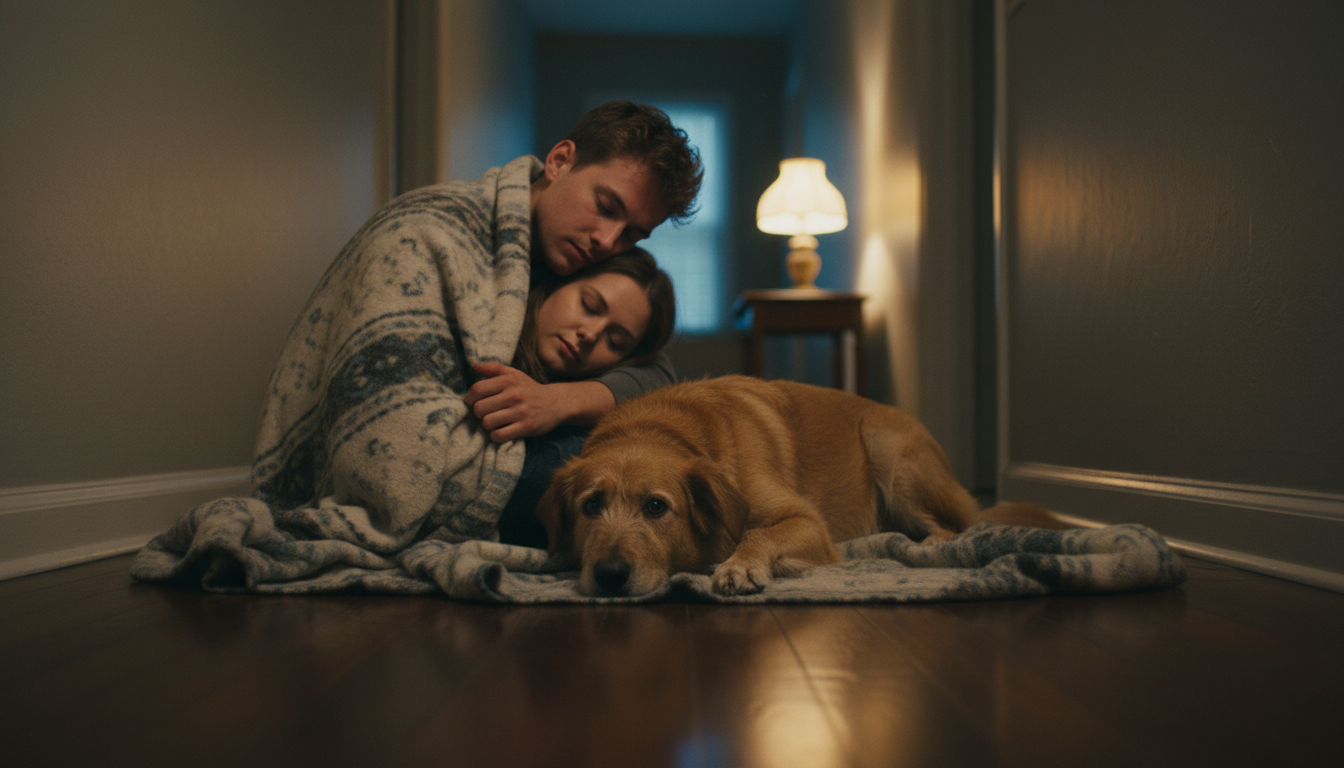
Understanding that Ollie needed to feel grounded, Sarah made a decision that would change the trajectory of their bond. She didn’t force him. Instead, she grabbed a blanket and a pillow from the bed and climbed down onto the hardwood floor in the hallway, sitting a few feet away from the trembling dog.
She didn’t touch him or look him in the eye. She just sat there, reading a book on her phone with the brightness turned down. Mark soon joined her, bringing a duvet cover to spread on the floor. For the next three hours, the humans sat on the hard floor, simply existing in the same space as their terrified new family member.
Around 4:30 AM, the breakthrough happened. Ollie stopped pacing. He took a deep, shuddering breath—a sign of the parasympathetic nervous system finally engaging. Slowly, painfully slowly, he lowered his front paws. Then his back paws. He didn’t lay on the blanket, but he laid on the bare floor right next to Sarah’s leg. His head grew heavy, and for the first time in perhaps years, Ollie closed his eyes in a quiet room and slept.
Understanding the "Rule of Three"
Ollie’s struggle is a textbook example of why the "Rule of Three" is vital for new adopters to understand. According to behaviorists and rescue organizations like the ASPCA and local humane societies, rescue dogs go through three distinct phases of decompression:
- 3 Days: The dog is overwhelmed, scared, and may not eat or drink. They are purely in survival mode.
- 3 Weeks: The dog starts to settle in, learning the routine, though behavioral issues may start to appear as they get comfortable.
- 3 Months: The dog finally feels secure and builds true trust and bonding.
Ollie was in the thick of those first three days. His refusal to sleep wasn’t disobedience; it was a biological response to trauma. By abandoning their expectations and meeting Ollie on his level—literally, on the floor—Sarah and Mark bridged the gap between fear and safety.
If you are interested in reading more about the psychology of rescue animals, check out our deep dive on decoding the silent signals your rescue dog is sending you.
The Road to Recovery
The morning after this dog’s first night in a home didn’t go as planned, things didn’t magically fix themselves. Ollie was still skittish. He still preferred the floor to the bed. But something had shifted. When Sarah walked into the kitchen, Ollie’s eyes followed her, not with fear, but with curiosity.
It took two weeks for Ollie to step one paw onto the dog bed. It took another month before he wagged his tail when Mark came home from work. And it took nearly four months before he finally hopped up onto the sofa, let out a long sigh, and fell asleep with his belly exposed—the ultimate sign of trust.
Rescue organizations emphasize that stories like Ollie’s are important because they manage expectations. Social media often shows the "after" photos—the smiling dog in a bandana. It rarely shows the sleepless nights, the accidents on the rug, or the hours spent sitting on the floor waiting for a dog to realize they don’t have to fight for survival anymore.
Why It Was Worth It
Today, Ollie is unrecognizable from the ghost-like dog who stood vigil in the hallway. He is a couch potato who hogs the blankets. But Sarah and Mark keep the photo of that first night—the empty dog bed and the messy pile of blankets on the hallway floor—as a reminder.
It reminds them that love isn’t just about providing a roof and food. It’s about providing patience. It’s about letting go of how you thought things would go and accepting them as they are. Ollie’s first night didn’t go as planned, but looking back, his family admits they wouldn’t change a thing. It was the night they learned to listen.
For more heartwarming stories about animals finding their forever families against the odds, read about the senior dog who waited 400 days for a second chance.
Adopting a rescue dog is a journey with no map. Sometimes you sleep in a bed, and sometimes you sleep on the floor. But as long as you are together, you are home.