It was a phone call that the Thompson family had rehearsed in their minds a thousand times, only to have the hope slowly extinguished by the passage of time. For nearly two years, their home had felt quieter, the backyard emptier, and their hearts heavier. But on a rainy Tuesday afternoon, the impossible happened.
In a story that highlights the unbreakable bond between humans and animals, a Golden Retriever mix named Barnaby was reunited with his owners after vanishing 500 days earlier. The miracle dog reunion has not only brought tears to the eyes of the shelter staff who witnessed it but has also served as a powerful testament to the resilience of lost pets and the critical importance of microchip technology.
The Day Barnaby Vanished
The nightmare began on a Fourth of July weekend two years ago. According to the family, Barnaby, then just three years old, had been spooked by the sudden crack of illegal fireworks in their quiet suburban neighborhood. Despite a high fence and a secure gate, the panic-stricken dog managed to dig his way out in a state of flight-or-fight terror.
“We looked everywhere,” David Thompson told local reporters shortly after the incident. “We put up flyers, we posted in every Facebook group, we hired a pet detective. Weeks turned into months, and eventually, people started telling us we needed to move on. But you never really move on when you don’t know what happened.”
For 18 months, there were no sightings. No leads. Just silence. The statistical likelihood of a reunion dropped with every passing season. See our guide on preventing pet loss during holidays here.
A Stray in the Storm
Fast forward to last week. Animal Control officers in a county forty miles away from the Thompson’s home responded to a call about a stray dog seeking shelter under a porch during a severe thunderstorm. The dog was matted, significantly underweight, and wary of humans—classic signs of an animal that had been surviving on its own for a long time.
Shelter staff at the County Animal Services intake center described the dog as “shut down.” He wouldn’t make eye contact and huddled in the back of his kennel. As part of the standard intake protocol, a veterinary technician waved a scanner over the dog’s shoulder blades, expecting nothing but a generic ID number or silence.
Instead, the scanner beeped.
That single beep set in motion a miracle dog reunion that would defy the odds. The microchip was registered. The contact information was current. And the phone number belonged to David Thompson.
The Science of Survival and Identification
Barnaby’s survival is a case study in canine resilience. Experts suggest that lost dogs often enter a “survival mode,” reverting to primal instincts to find food and shelter while avoiding human contact, even if they were previously socialized pets.
However, survival is only half the battle; identification is the key to coming home. According to the American Veterinary Medical Association (AVMA), dogs without microchips are returned to their owners only 21.9% of the time. However, for microchipped dogs, the return-to-owner rate jumps to 52.2%. In cases where owners cannot be found for chipped dogs, it is almost exclusively due to incorrect or outdated contact information in the registry database.
“This is exactly why we tell people to chip their pets and update the registry,” said the shelter director in a statement following the event. “Without that chip, Barnaby would have just been another stray looking for a new home, and his family would never have known he was safe.”
The Moment Everything Changed
When the shelter called David Thompson, he initially thought it was a prank. “I was at work,” he recalled. “I saw the number and almost didn’t answer. When they said they had Barnaby, I stopped breathing. I asked them to check the description three times.”
Within an hour, the family was at the shelter. The staff warned them that Barnaby might not recognize them immediately. He was traumatized, skinny, and exhausted. But what happened next silenced the room.
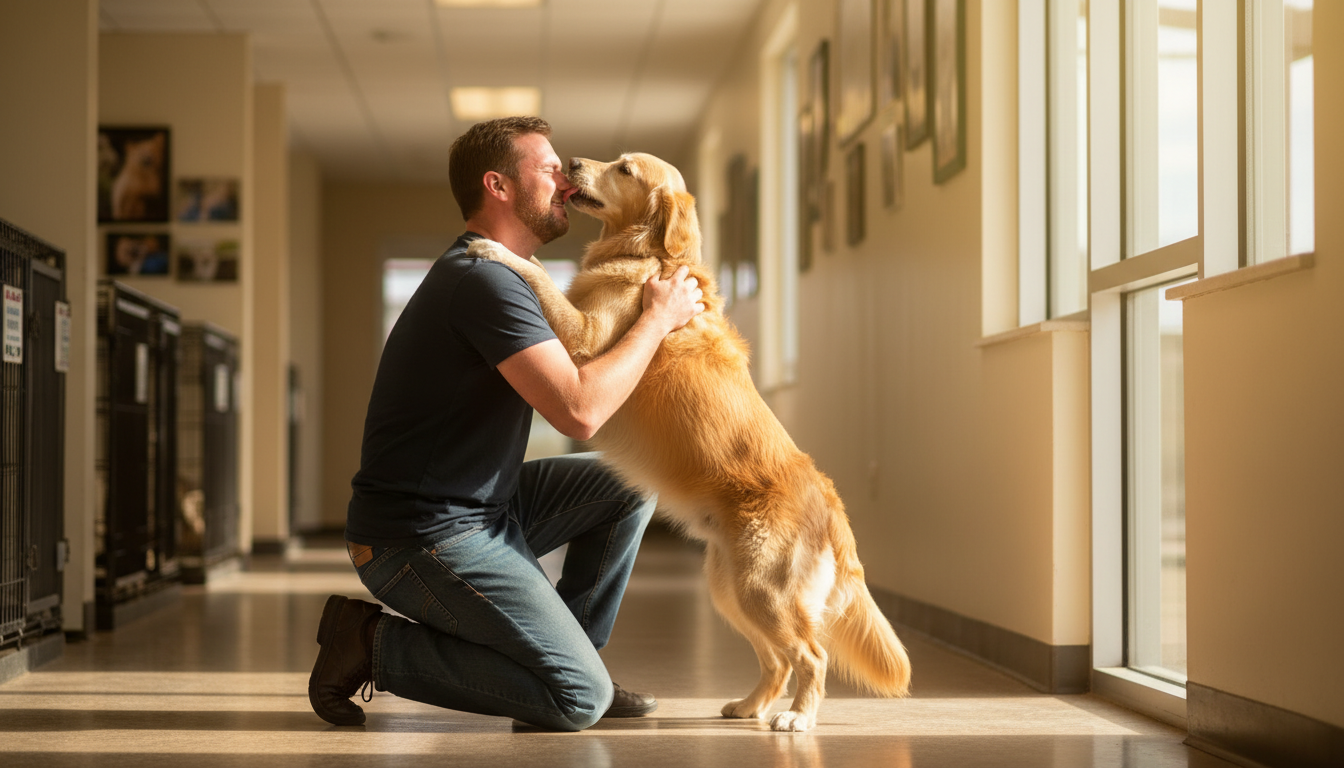
As David walked down the concrete hallway, he knelt outside the kennel door. He didn’t call out loud; he simply whistled a specific three-note tune he used to use when feeding Barnaby dinner. The dog, who had been facing the wall, froze.
Slowly, the golden head turned. The ears, previously pinned back in fear, perked up. Barnaby took a tentative step, sniffed the air, and then the recognition hit him like a physical wave. He let out a whimper that escalated into a joyful bark, throwing his body against the kennel door.
“It was instantaneous,” a shelter volunteer described. “The second the door opened, that dog was in his dad’s lap. There wasn’t a dry eye in the hallway. It was the kind of miracle dog reunion you usually only see in movies.”
Healing and moving Forward
The road to recovery for Barnaby has just begun. He has lost nearly 15 pounds and is being treated for minor infections and tick-borne illness, typical for a dog who has been living rough for 500 days. However, veterinarians expect him to make a full physical recovery.
The emotional recovery is already well underway. The Thompsons report that Barnaby has reclaimed his spot on the living room rug and sleeps by the foot of their bed, refusing to let them out of his sight. The trauma of the last year and a half seems to dissipate with every meal and belly rub.
Stories like this serve as a beacon of hope for the thousands of families currently searching for missing pets. It is a reminder that time and distance are not always insurmountable barriers. Read more amazing rescue stories from our archives here.
How to Protect Your Pet
In light of Barnaby’s safe return, local animal control agencies are urging pet owners to take proactive steps:
- Microchip your pets: It is the only permanent form of identification.
- Check the chip: Ask your vet to scan the chip annually to ensure it hasn’t migrated or malfunctioned.
- Update your info: If you move or change phone numbers, update the manufacturer’s database immediately.
- Don’t give up: As Barnaby proved, a reunion can happen days, months, or even years later.
For the Thompson family, the silence of their home has been replaced once again by the clicking of claws on hardwood floors and the happy panting of a dog who finally found his way back.