For the Miller family, the silence in their suburban home had become deafening. It had been 14 weeks since the frantic scratching of paws against the hardwood floor had ceased, 14 weeks since the jingle of a collar announced the arrival of their beloved Golden Retriever mix, Cooper. Like thousands of families who face the heartbreak of a lost pet every year, the Millers had exhausted every resource, hung every flyer, and chased every lead. They had reached the point of agonizing acceptance, believing their “missing dog found” story would never come to pass.
But fate, and a dedicated network of animal lovers, had a different ending in mind. Just as the family decided to take down the faded posters taped to telephone poles around their neighborhood, a phone rang at 11:45 PM on a rainy Tuesday. That late-night call would not only shatter the silence but restore a family’s faith in miracles.
The Day the World Went Quiet
The nightmare began on a humid afternoon in July. According to neighbors, a sudden, unpredicted thunderstorm rolled through the area with startling intensity. Cooper, a rescue dog with a known fear of thunder, had been in the backyard while John Miller ran a quick errand. Despite the six-foot fence, the panic induced by the thunder was enough to drive Cooper to desperate measures. By the time John returned twenty minutes later, a slat in the fence had been pried loose, and the yard was empty.
“It is the moment every pet owner dreads,” John Miller shared in a later recount of the events. “You call their name, expecting them to come running, and when they don’t, the panic sets in instantly.”
The first few days were a blur of activity. The family mobilized a search party, contacting local community rescue groups and posting on every social media platform available. They followed the standard advice: leaving food out, placing familiar-smelling clothing near the door, and visiting local shelters daily. But as days turned into weeks, the leads dried up. Sightings became sporadic and unreliable. The hope that fueled their initial search began to wane, replaced by a hollow grief.
The Statistics Against Them
The reality of missing pets is stark. According to the American Humane Association, approximately 10 million dogs and cats are lost or stolen in the United States every single year. Tragically, a significant percentage of these animals never make it back home. For dogs without identification or microchips, the return-to-owner rate at shelters is distressingly low, often hovering around 15%.
The Millers knew these statistics. They knew that with every passing day, the likelihood of a missing dog found safe and sound decreased exponentially. They worried about traffic, predators, and the elements. But what they didn’t account for was the resilience of their dog and the kindness of strangers.
The Late-Night Discovery
Seventy miles away from the Miller’s home, in a rural county that hadn’t seen the “Lost Dog” posters, a woman named Sarah Jenkins spotted a gaunt, matted dog huddled under the porch of her farmhouse. He was wary, frightened, and looked nothing like the vibrant dog in the Millers’ photos. Jenkins, a long-time volunteer with a regional animal rescue, knew the drill.
“He was in rough shape,” Jenkins told local shelter staff. “He looked like he had been on his own for a long time. But there was a sweetness in his eyes that told me he belonged to someone.”
It took Jenkins three days to coax the dog into her car using treats and gentle patience. She drove him to the County Animal Control center late that Tuesday evening, where the night-shift veterinary technician, Elena Ross, performed the routine intake exam. It was standard procedure: check for injuries, check for fleas, and scan for a microchip.
The scanner beeped.
The Call That Changed Everything
At the Miller household, the phone ringing at nearly midnight was alarming. Few good things happen after 11 PM, or so the saying goes. When Mary Miller picked up the phone, she expected a wrong number or perhaps a family emergency.
“Is this Mrs. Miller?” the voice on the other end asked. “My name is Elena, and I’m calling from County Animal Services. I believe we have Cooper.”
Mary describes the moment as surreal. She had to ask the technician to repeat the microchip number twice. It was a match. The missing dog found miles from home was indeed Cooper. The technician explained that despite losing significant weight and suffering from a minor paw infection, Cooper was alert and responsive.
An Emotional Reunion
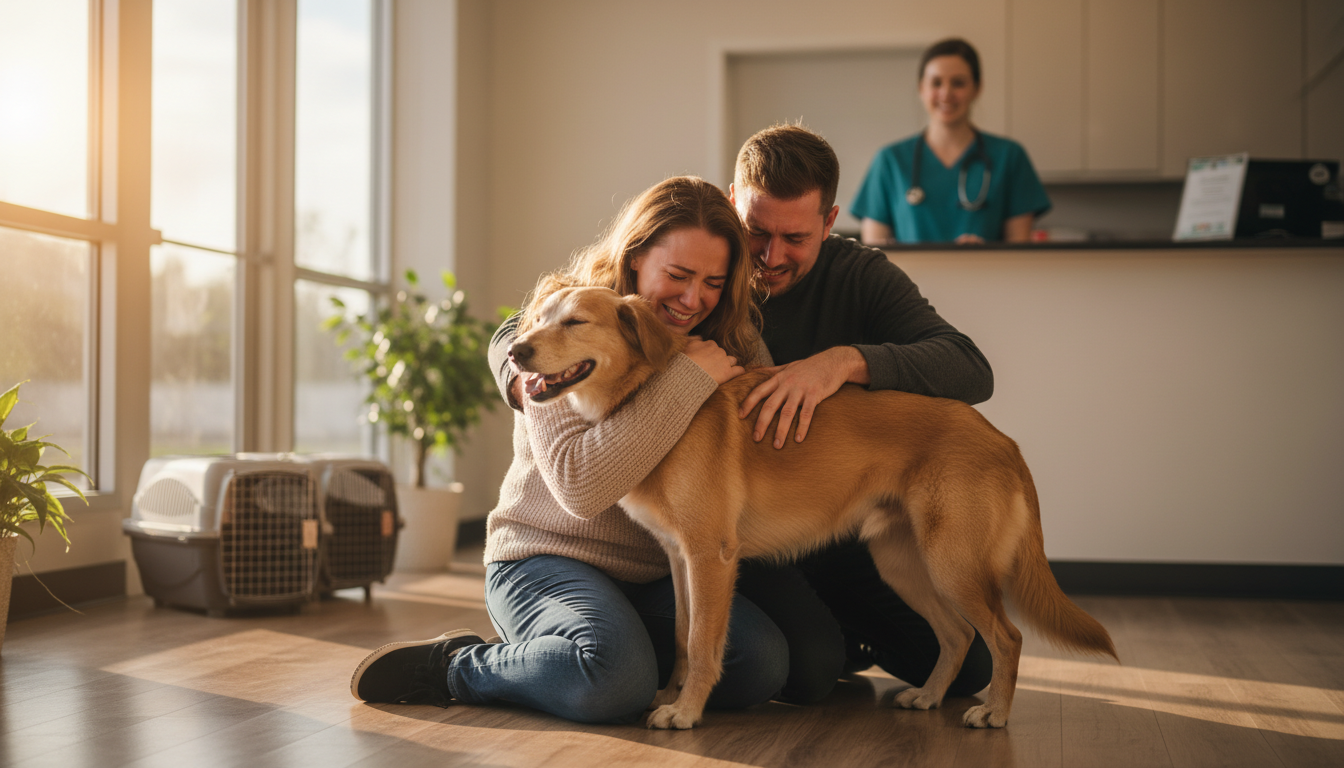
The drive to the shelter the next morning felt like the longest journey of their lives. When the staff brought Cooper out into the waiting area, the reaction was immediate. Despite his weakened state, Cooper’s tail began a low, rhythmic thump the moment he heard John’s voice. When he saw them, the thump turned into a full-body wag, and he let out a whine that the family described as pure relief.
Video footage taken by shelter staff shows the family collapsing to the floor to embrace the dog they thought they had lost forever. It is a scene that plays out in shelters across the country, but for the Millers, it was the only moment that mattered.
“To see the light come back into his eyes was incredible,” said the shelter director. “These are the days that keep us going in animal welfare. Seeing a bond that strong, that survives months of separation, is a testament to the relationship between humans and their pets.”
The Power of the Microchip
This story serves as a powerful reminder of the importance of microchipping pets. While collars can fall off and tags can become illegible—Cooper had lost his collar weeks prior—a microchip remains the only permanent form of identification.
Veterinarians emphasize that a microchip is not a GPS tracker; it requires a scanner to read the unique ID number, which is then linked to a database with the owner’s contact information. In Cooper’s case, the Millers had diligently kept their contact info updated in the registry, a small administrative task that ultimately saved their dog’s life.
For readers interested in learning more about pet safety, read our guide on essential safety tips for dog owners to prevent escapes before they happen.
Life After the Return
Today, Cooper is back to his healthy weight and has resumed his post on the living room rug. The emotional scars of his time away are fading, though his family notes he is stickier—he rarely leaves their side when they are home. The fence has been reinforced, and the family has added a GPS collar as a backup measure.
The Millers’ story is more than just a happy ending; it is a beacon of hope for those still searching. It reminds us that time and distance are not always insurmountable barriers. Sometimes, when hope is all but gone, a scanner beeps, a phone rings, and a family is made whole again.