It began as a call that animal control officers receive all too often: a stray puppy found abandoned on the side of a rural highway, motionless and shivering. When rescuers from the local humane society arrived on the scene, they discovered a small, mixed-breed puppy, estimated to be only eight weeks old. He was alert, his tail giving a faint, hopeful wag, but his hind legs dragged uselessly behind him in the dirt.
Staff named him “Barnaby,” but the optimism of a name couldn’t mask the severity of his condition. Upon arrival at the veterinary trauma center, the initial prognosis was grim. X-rays revealed severe spinal trauma, likely the result of being struck by a vehicle or a congenital defect exacerbated by malnutrition. According to the attending veterinarians, Barnaby had zero deep pain sensation in his rear limbs—a clinical marker that often suggests permanent paralysis.
For many shelters facing overcrowding and limited resources, a paralyzed puppy recovery journey is often deemed too expensive or labor-intensive to undertake. Euthanasia is a heartbreaking but common reality in such severe cases. However, the shelter staff noticed something distinct about Barnaby. despite his injury, he pulled himself forward with immense upper-body strength and greeted every medical technician with kisses. They decided to give him a fighting chance, reaching out to a specialized foster carer experienced in canine rehabilitation.
A Grim Diagnosis and a Glimmer of Hope
The first few weeks were grueling. Barnaby required round-the-clock care, including manual bladder expression and frequent rotation to prevent pressure sores. According to the American Veterinary Medical Association (AVMA), rehabilitation for spinal injuries in canines is a multi-faceted discipline that requires dedication, patience, and often, significant financial investment. It is not merely about healing bones; it is about retraining the nervous system.
Barnaby’s foster mother, Sarah, described the early days as emotionally taxing. “There were nights where I questioned if we were doing the right thing,” she told shelter staff. “He wanted to play with the other dogs so badly, but he would just drag his legs and eventually collapse in exhaustion. It was heartbreaking to watch a puppy who just wanted to be a puppy trapped in a broken body.”
The treatment plan involved strict crate rest, anti-inflammatory medications, and eventual passive range-of-motion exercises. The goal was to keep his muscles from atrophying while waiting to see if the swelling around his spine would subside enough to allow nerve signals to reconnect. For a month, there was no change. His back legs remained limp, and the vet team began to discuss measuring him for a permanent wheelchair.
The Long Road of Paralyzed Puppy Recovery
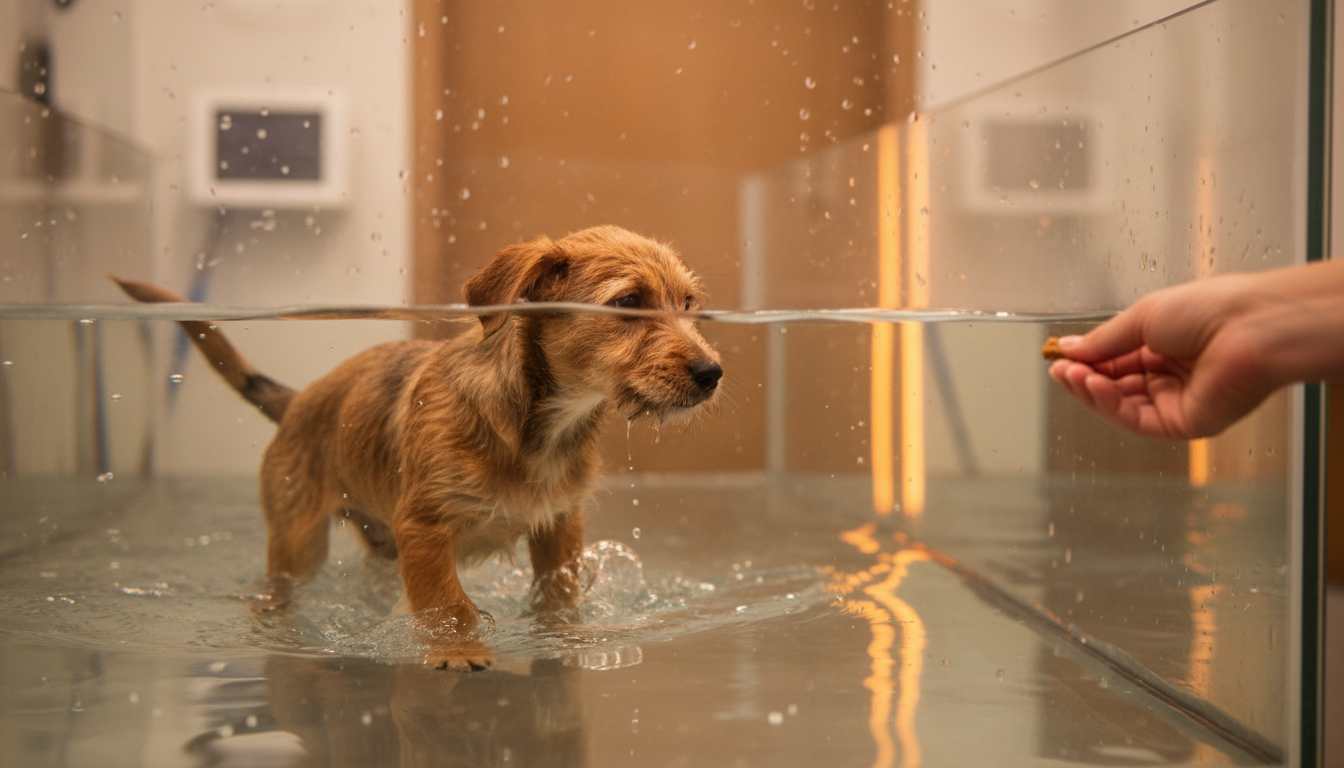
Refusing to give up, the rescue organization raised funds to enroll Barnaby in a professional canine rehabilitation program involving hydrotherapy. Water therapy is crucial for spinal injuries because the buoyancy of the water supports the dog’s weight, allowing them to move their limbs without fighting gravity. This helps build muscle mass and improves circulation, which is vital for nerve healing.
During his first few sessions in the underwater treadmill, technicians had to manually move Barnaby’s back legs to simulate a walking motion. This process, known as “patterning,” attempts to remind the spinal cord how to walk. It is a slow, repetitive process that offers no guarantees. Read more about extraordinary dog rescue stories to understand the resilience these animals possess.
Week after week, Barnaby was lowered into the tank. He paddled furiously with his front paws, his eyes wide, but his back legs dangled. The rescue community followed his updates online, sending donations and prayers, but the medical consensus remained skeptical. The window for recovery was closing. Usually, if function doesn’t return within the first six to eight weeks post-trauma, the likelihood of walking again drops significantly.
The Moment Everything Changed
It was a Tuesday morning, nearly two months into his rescue, when the impossible happened. Barnaby was in the water tank, the technicians supporting his hips as usual. Suddenly, the therapist felt a twitch. It wasn’t a reflex; it was a deliberate push.
“Everyone froze,” the hydrotherapist reported to the rescue team. “We stopped moving his legs for him, just to see what would happen.”
Then they saw it. Barnaby, focusing intensely on a treat held at the front of the tank, kicked his left rear leg. Then his right. It was uncoordinated and weak, but it was voluntary movement. The room erupted in cheers, though Barnaby seemed more interested in the treat he had earned. This was the breakthrough needed to shift his prognosis from “permanently disabled” to “recovering.”
The progress that followed was exponential. Once the neural pathways reconnected, Barnaby’s determination took over. He graduated from the water tank to dry land, initially stumbling and falling, looking like a “drunken sailor,” as his foster mom lovingly described. But he never stopped getting back up.
The Science Behind the Miracle
While Barnaby’s recovery feels like magic, it is grounded in the science of neuroplasticity. Veterinary neurologists explain that in young animals, the nervous system is incredibly adaptable. Surviving neurons can sometimes sprout new pathways to bypass damaged areas of the spinal cord, a process aided by the repetitive stimulation of physical therapy.
Organizations like the ASPCA advocate strongly for the treatment of special needs animals, noting that animals with mobility issues can live full, happy lives. Barnaby serves as a testament to why second chances matter. Had he been evaluated solely on his condition at intake, his story would have ended before it began.
“It is a reminder to all of us in the veterinary field,” said Dr. Miller, a specialist who consulted on the case. “Clinical signs tell us the current state of the animal, but they cannot measure the animal’s will to survive or the impact of dedicated care.”
What Happens Next for Barnaby
Today, Barnaby is no longer the dragging puppy found by the roadside. While he still has a slightly unique gait—a “wobble” when he runs too fast—he is fully mobile. He runs, jumps on the couch, and chases squirrels with the enthusiasm of a dog who knows no limits.
The video of his first independent steps went viral within the rescue community, not just because it was cute, but because it represented a victory over hopeless odds. It highlighted the importance of foster carers who bridge the gap between rescue and adoption, providing the daily physical therapy that shelters often cannot support.
Barnaby has since been adopted by a family who followed his paralyzed puppy recovery story from the beginning. They report that he is the most grateful, affectionate dog they have ever owned. His physical scars have healed, and his emotional resilience continues to inspire thousands on social media.
For more heartwarming tales of animals overcoming the odds, explore our section on miraculous animal recoveries.
Barnaby’s story is a powerful reminder: sometimes, when the experts say “never,” a dog’s spirit says “watch me.”