When animal control officers first arrived at the abandoned property in rural Ohio, the silence was deafening. There were no barks, no growls, and no signs of movement. It wasn’t until they navigated through debris in a dilapidated barn that they found him: a Shepherd mix, curled so tightly into the corner of a rusted wire crate that he appeared significantly smaller than he actually was.
The dog, later named Barnaby, was trembling with such intensity that the crate rattled against the concrete floor. His fur was matted with filth, his ribs were visible, and his eyes—wide with panic—refused to meet the gaze of his rescuers. According to the initial intake report from the county shelter, Barnaby was designated as a “severe shutdown” case. He wasn’t aggressive; he was terrified to the point of catatonia.
For many dogs in this condition, the prognosis is grim. The trauma of long-term neglect often leaves scars that are far more difficult to heal than broken bones. Shelter staff worried that it might be impossible for this dog to trust again. However, what happened over the next six months would challenge everything the seasoned rescue team knew about resilience, patience, and the healing power of a quiet home.
The Reality of Canine Trauma
Barnaby’s story is not unique, but his reaction to his rescue was extreme. Veterinary behaviorists explain that dogs subjected to prolonged isolation or abuse often suffer from a form of canine PTSD. When Barnaby arrived at the rescue center, he had to be carried; his legs refused to work out of fear. Once placed in a kennel, he pressed himself against the back wall, facing away from the door, a behavior known as “pancaking” or shutting down.
According to staff at the shelter, for the first three days, Barnaby refused to eat in the presence of humans. He would only take food overnight when the lights were off and the building was silent. The staff knew that a busy, loud kennel environment was the worst possible place for a dog in his psychological state. If he didn’t show signs of improvement, he would become unadoptable. The clock was ticking.
“We see this heartbreaking disconnect in dogs who have never known a kind touch,” a senior volunteer told local reporters at the time. “They don’t know that a hand is for petting. They think it’s for hurting. Getting a dog to trust again after that level of betrayal requires a miracle or a very special foster parent.”
A Foster Step Forward
The miracle came in the form of Sarah Jenkins, an experienced foster carer with a specialty in unsocialized dogs. Jenkins, who has rehabilitated over a dozen “hospice-hearted” dogs, agreed to take Barnaby into her home, fully understanding that he might never be a “normal” pet. The goal wasn’t adoption yet; it was simply decompression.
The ASPCA notes that fear is a powerful motivator in dogs, and overcoming it requires desensitization and counter-conditioning. Jenkins applied the “3-3-3 rule” of rescue—three days to decompress, three weeks to learn the routine, and three months to start feeling at home—but she knew Barnaby would need much longer.
For the first two weeks, Barnaby lived in a secure exercise pen in Jenkins’ living room. She didn’t try to pet him. She didn’t try to walk him. She simply existed near him. She would sit on the floor a few feet away, reading a book aloud in a soft voice, tossing high-value treats like boiled chicken near his paws without making eye contact. It was a slow, agonizing process of proving to him that her presence predicted good things, not pain.
The Moment Everything Changed
The breakthrough didn’t happen with a cinematic explosion of joy. It happened in the quiet hours of a Tuesday morning. Jenkins reported that she was sitting on the floor with her morning coffee, ignoring Barnaby as usual, when she felt a cold nose touch her elbow.
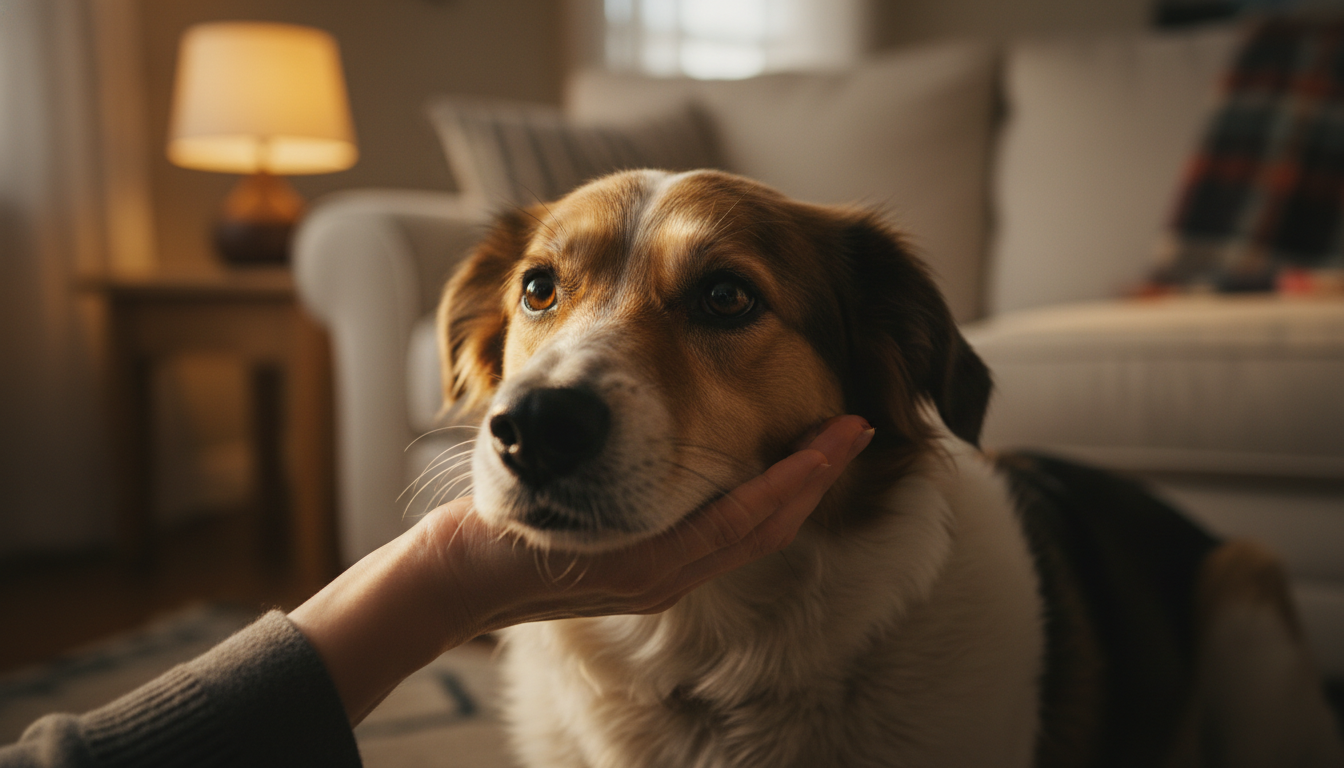
She froze, barely breathing, allowing the interaction to happen on his terms. Barnaby, the dog who had spent weeks pressing himself into corners to become invisible, sniffed her arm. He retreated, then stepped forward again. Then, he let out a long, heavy sigh and laid his chin on her leg.
“It was the moment the wall came down,” Jenkins later shared on her foster blog. “He decided to take a risk. He decided that maybe, just maybe, I wasn’t going to hurt him. It was the first time I saw the light come back into his eyes.”
From that morning on, the progress was exponential. Barnaby began to wag his tail—a low, tentative sway at first, which eventually turned into a full-body wiggle when Jenkins entered the room. He discovered toys, showing a particular fondness for a squeaky plush hedgehog. He learned to walk on a leash, though he still preferred the safety of the backyard to the open street.
The Bond Between Humans and Animals
Barnaby’s journey highlights the incredible neuroplasticity of the canine brain and the depth of the human-animal bond. While he still has moments of hesitation when strangers move too quickly, he is no longer the ghost of a dog found in that barn. His story serves as a reminder that “unadoptable” is often just a label for “misunderstood.”
Rescue organizations frequently emphasize that fostering saves lives. By moving Barnaby out of the high-stress kennel environment, he was given the space to reset his nervous system. For readers interested in similar stories, you can read about other senior dog rescue transformations that showcase the power of patience.
This case also sheds light on the importance of reporting animal neglect. Without the initial call from a concerned neighbor who noticed the lack of activity at the property, Barnaby likely would not have survived another winter. His physical recovery—gaining 15 pounds and treating a severe skin infection—was straightforward compared to the emotional mountain he had to climb.
What Happens Next for Barnaby
Six months after his rescue, Barnaby was officially made available for adoption. However, in a twist that delighted his growing social media following, he didn’t go far. Jenkins, the woman who taught this dog to trust again, made the decision to adopt him formally. She realized that disrupting his world again could cause a regression, and more importantly, she had fallen in love with his gentle, resilient soul.
“He saved me just as much as I saved him,” Jenkins said. “Watching him discover the world—grass, snow, soft beds—it changes your perspective on everything.”
Barnaby now spends his days lounging on the sofa, playing with his squeaky hedgehog, and serving as a “therapy brother” to new foster dogs that Jenkins brings home. He helps show the new, terrified arrivals that they are safe, acting as a bridge between their trauma and their future.
His story is a testament to the fact that no animal is broken beyond repair. With enough time, love, and the right environment, even the most fearful spirit can find its way back to the light. For more heartwarming tales of recovery, explore our feature on animals overcoming impossible odds.