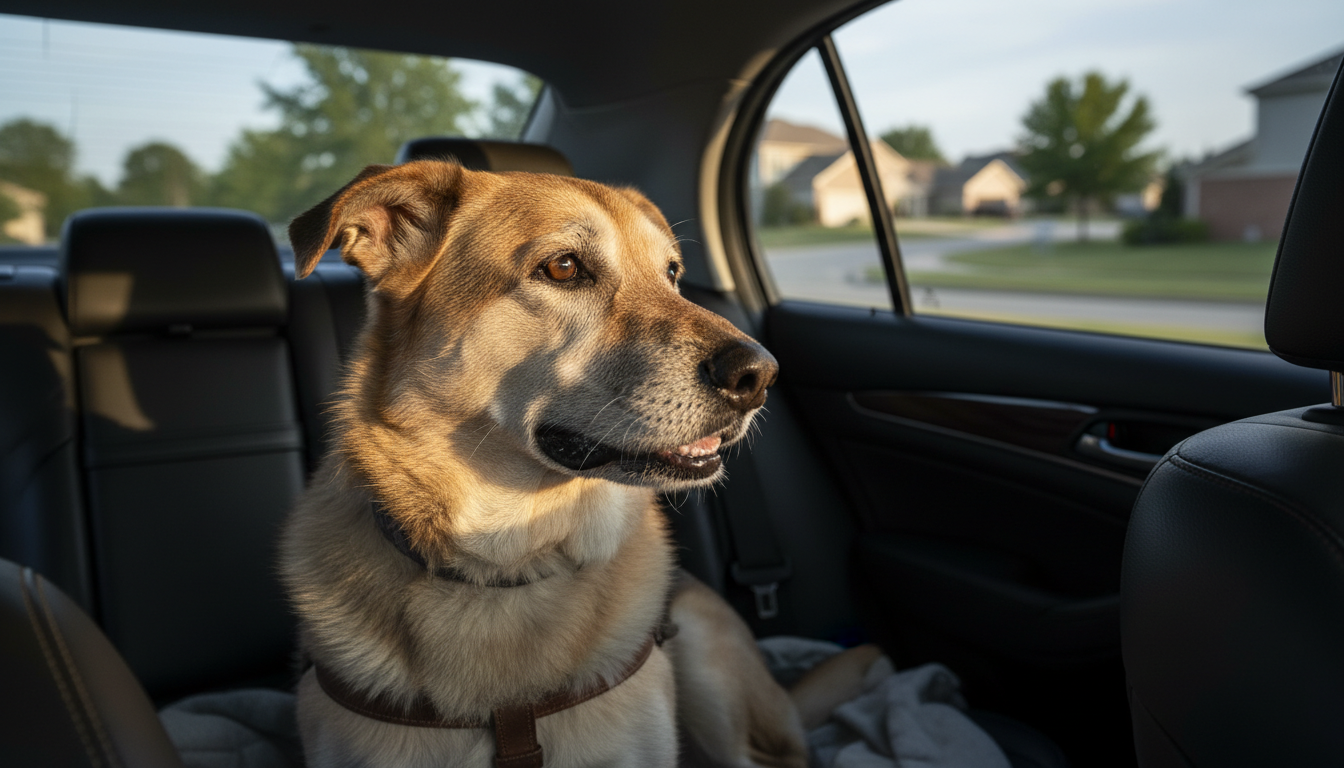
The fluorescent lights of the county animal control facility buzzed with a sound that becomes deafening when you are sitting in silence. For Bear, a seven-year-old Shepherd mix with a greying muzzle and eyes that held a lifetime of questions, the noise was the only constant companion he had left. His paperwork was stamped with a grim red designation. Due to severe overcrowding and a lack of kennel space, Bear was scheduled for euthanasia at 5:00 PM on a Tuesday.
It is a scenario that plays out in shelters across the country daily. According to data from the ASPCA, approximately 390,000 dogs are euthanized in U.S. shelters every year. While many facilities strive for “no-kill” status, municipal shelters are often legally required to take in every stray, leading to heartbreaking decisions when capacity is reached. Bear was simply a victim of mathematics: too many dogs, not enough cages.
But just as the clock ticked toward the final hour, a phone rang in the shelter director’s office. It was a call that would alter the trajectory of Bear’s life forever, proving that sometimes, hope arrives in the very last second.
The Reality of the “Red List”
To understand the gravity of Bear’s situation, one must understand the “Red List.” In the world of animal rescue, this list contains the names of animals who have run out of time. These dogs are often seniors, have minor medical issues, or simply display kennel stress—spinning, barking, or shutting down—which makes them “unadoptable” to the general public walking through the aisles.
Shelter staff described Bear as a “gentle soul” who had simply shut down. He didn’t bark for attention; he pressed his forehead against the cold chain-link fence, closing his eyes as people passed him by. He had been surrendered by a family facing housing insecurity, a growing crisis that animal welfare organizations report is a leading cause of owner surrenders today. Confused and abandoned, Bear had stopped eating, a sign of deep depression that often accelerates a dog’s placement on the euthanasia list.
“He wasn’t aggressive, and he wasn’t sick beyond needing a good meal and a bath,” a shelter volunteer noted in his file. “He was just heartbroken.”
The Network of Hope
While Bear waited, a digital army was mobilizing. Local rescue volunteers often photograph dogs on the Red List, circulating their images on social media in a desperate bid for a foster home or a rescue commitment. Bear’s photo—a grainy image showing his soulful, sad eyes—began to circulate in local rescue groups.
It was this photo that caught the eye of Sarah, a coordinator for a foster-based rescue organization two hours away. She saw something in Bear’s posture that reminded her of her own childhood dog. However, seeing the photo was not enough; the logistics of pulling a dog scheduled for euthanasia are complex. The rescue needed a confirmed foster home and transport immediately.
“We had 45 minutes left before the shelter closed its doors to rescues for the day,” Sarah recounted later. “I started making calls. I called five regular fosters. All full. I was about to give up when I dialed a new number—a woman named Elena who had applied to foster months ago but hadn’t been active.”
Elena answered on the second ring. She listened to Sarah’s frantic explanation. There was a pause on the line that felt like an eternity. Then, Elena said the words that saved a life: “I can be there in an hour. Go get him.”
The Moment Everything Changed
Sarah immediately placed the call to the shelter. “Do not put Bear down. We are tagging him. Transport is en route.”
Shelter staff later described the moment they went to Bear’s kennel, not with a catch-pole for the final walk to the medical room, but with a simple slip lead for a walk to the front lobby. Reports from the staff indicated that Bear seemed to sense the shift in energy. He stood up, shook his coat, and for the first time in days, wagged his tail—a slow, tentative thump against the concrete wall.
When Elena arrived, the meeting was emotional. Like many emotional reunions and rescues, the connection was instant. Bear leaned his entire weight into Elena’s legs, letting out a long sigh that seemed to release weeks of tension. He was lifted into the backseat of a car, leaving the smell of bleach and fear behind him.
The Freedom Ride and Recovery
The drive away from a shelter is famously known in the rescue community as the “Freedom Ride.” For a dog scheduled for euthanasia, it is a rebirth. Bear’s first stop was a drive-thru for a plain cheeseburger—a tradition for many rescuers—which he ate with gentle politeness.
However, the road to recovery wasn’t instant. Upon arriving at Elena’s home, Bear slept for nearly 24 hours straight, a common reaction known as “shelter decompression.” Veterinary checks revealed he had neglected teeth and an ear infection, common ailments that are easily treatable but often fatal in a shelter environment due to resource constraints.
Over the next few weeks, Bear transformed. The grey-muzzled senior who had pressed his head against the shelter bars began to play. Videos shared by the rescue showed him discovering a basket of squeaky toys, tossing a plush hedgehog into the air with the enthusiasm of a puppy.
A Forever Home Found
The story of the dog who was minutes away from death went viral within the rescue’s community. It wasn’t long before an application came in from a retired couple looking for a calm companion. They weren’t looking for a high-energy puppy; they wanted a soul who had lived a little.
Today, Bear spends his time napping on a memory-foam orthopedic bed and taking slow walks around a local lake. His past as a number on a euthanasia list is a distant memory, replaced by the security of a routine and unconditional love.
The Importance of Fostering
Bear’s story underscores a critical reality in animal welfare: fostering saves lives. Without Elena saying “yes” to that phone call, the rescue organization could not have pulled Bear. Shelters are physical buildings with limited walls, but foster networks are limitless, constrained only by the number of people willing to open their homes.
If you have ever considered helping animals, look into local dog rescue opportunities. You don’t always need to adopt to make a difference. Sometimes, all it takes is answering the phone and offering a temporary safe haven to a dog who has run out of time.
Bear was scheduled for euthanasia because he had nowhere to go. Now, he has everywhere to go. His life is a testament to the power of one phone call, one foster, and the community that refuses to give up on the “unadoptable.”