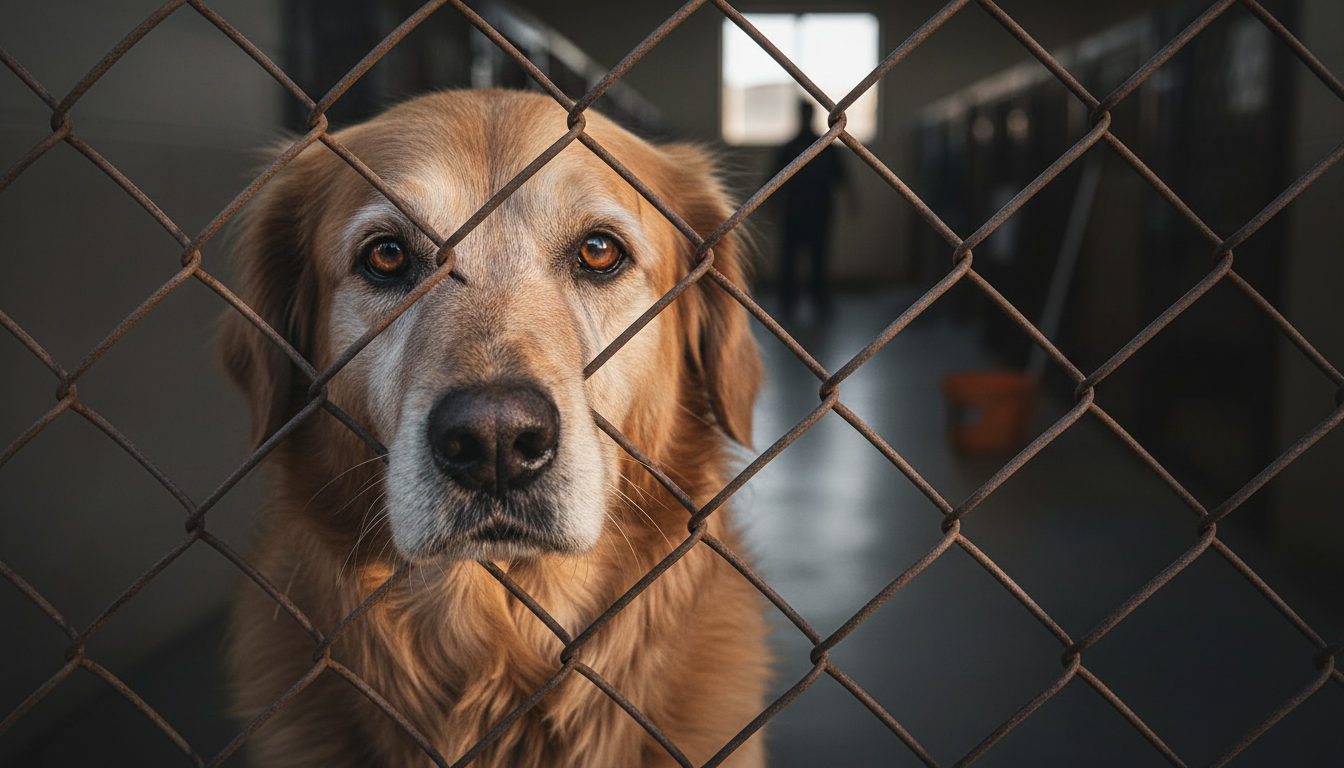
The fluorescent lights of the municipal animal control center hummed with a detached, clinical monotony, a stark contrast to the chaotic emotional energy that filled the corridors below them. For Barnaby, a six-year-old mixed breed with soulful amber eyes and a coat the color of dried wheat, the environment was overwhelming. He sat pressed against the cold concrete wall of kennel run 42, trembling slightly as visitors walked past him, their eyes glazing over the grey muzzle that hinted at his age.
Barnaby was not aggressive, nor was he ill. His only crime was being an older, large-breed dog in a shelter system bursting at the seams. With intake numbers rising and adoptions slowing down, the facility had been forced to make difficult decisions. On a Tuesday morning, a red card was clipped to his paperwork. The grim reality was set: he was scheduled for euthanasia by close of business on Friday if no one claimed him.
This is the story of how a network of compassionate strangers, a desperate plea on social media, and one critical phone call intervened in the final hour to rewrite a tragedy into a triumph.
The Reality of the Red List
To understand the gravity of Barnaby’s situation, one must understand the crisis facing municipal shelters across the country. Open-intake facilities are often legally required to accept every animal brought to their doors, regardless of space. When capacity is reached, tough choices are made based on adoptability and length of stay.
According to data from the ASPCA, approximately 920,000 shelter animals are euthanized each year in the United States. While this number has decreased historically, the post-pandemic era has seen a surge in owner surrenders, putting immense pressure on shelter staff who care deeply for the animals but are bound by lack of resources.
Barnaby had been surrendered by a family moving overseas who felt they couldn’t take him. Confused and heartbroken, he shut down in the shelter environment. He stopped eating and wouldn’t approach the kennel gate to greet potential adopters. In the high-stakes world of shelter adoptions, a dog that doesn’t “show well” is often overlooked. His silence was mistaken for disinterest, and his fear was mistaken for aloofness. As the days ticked by, he moved closer to the deadline.
The Clock Ticks Down
By Friday morning, the shelter staff—many of whom had grown fond of the gentle dog who would nudge their hands for treats—were solemn. A volunteer named Sarah took to social media one last time. She posted a video of Barnaby, capturing a moment where he rested his head on her lap, letting out a heavy sigh.
“This is Barnaby,” the caption read. “He is scheduled for euthanasia at 5:00 PM today. He is a good boy who just lost his home. Please, don’t let him end like this.”
The post began to gain traction, shared by local community groups and animal advocates. However, likes and shares do not always translate to rescues. As the clock hit 3:30 PM, the shelter lobby was quieting down. The veterinary team was beginning to prepare the list for the evening. Barnaby remained in run 42, unaware that his time was measured in minutes.
The Call That Changed Fate
Three hundred miles away, the intake coordinator for a dedicated senior dog sanctuary was scrolling through her feed during a break. The video of Barnaby caught her eye. It wasn’t just his sad demeanor; it was the specific look of resignation she had seen in hundreds of dogs before him. She felt an immediate pull.
She checked the timestamp. 3:45 PM. The shelter closed to the public at 5:00 PM, but administrative processing usually stopped earlier.
With trembling fingers, she dialed the shelter’s main line. It rang. And rang. In busy shelters, phones often go unanswered due to the sheer volume of calls. She hung up and dialed the direct line for the rescue coordinator, a number she had saved from a previous transport years ago.
“This is Animal Control, please hold,” a voice said.
“I can’t hold,” she insisted, her voice urgent. “I’m calling about ID number A49202. Barnaby. He is scheduled for euthanasia today. We are pulling him. Do not put him down.”
There was a pause on the other end, followed by the sound of keyboard typing. “Let me check his status,” the shelter employee said. The seconds felt like hours. Finally, the voice returned, softer this time. “You caught us just in time. The paperwork was already on the desk. I’m tagging him ‘Rescue Pending’ right now.”
The Freedom Ride
The logistics of moving a dog 300 miles on a Friday evening are never simple, but the rescue community is nothing if not resourceful. A chain of volunteer drivers, often referred to as a “transport train,” was assembled within an hour.
When the shelter staff went to get Barnaby, it wasn’t to walk him to the medical room. Instead, they walked him out the front door. The change in his demeanor was almost instantaneous. As he stepped out of the sterile, loud facility and into the fresh evening air, his tail gave a tentative wag. He was loaded into the back of a volunteer’s SUV, secured for his freedom ride.
Photos from that transport show a dog transformed. In one image, Barnaby is sleeping deeply on the back seat, his mouth open in a relaxed grin, the tension of the kennel finally leaving his body.
A New Lease on Life
Barnaby arrived at the sanctuary late that night. A medical evaluation revealed that aside from some dental issues and mild arthritis—common in dogs his age—he was healthy. The “unadoptable” label he had carried in the municipal shelter quickly dissolved.
“He just needed to decompress,” the sanctuary director noted in a later update. “Once he realized he was safe, the puppy in him came back out.”
Two weeks later, the sanctuary received an application from a retired couple looking for a companion. They wanted a dog who was past the chewing stage, someone who would enjoy leisurely walks and long naps on the porch. They weren’t looking for a project; they were looking for a friend.
When they met Barnaby, he didn’t retreat to the wall. He walked right up to the husband and leaned his entire body weight against his leg—a classic sign of trust. The adoption was finalized that day.
The Ripple Effect of Rescue
Barnaby’s story is a powerful reminder of the thin line between life and death for shelter animals. Being scheduled for euthanasia is often a matter of space and timing rather than a reflection of the animal’s worth.
His survival has also inspired others. The video that saved his life was updated with his “Going Home” photo, reaching thousands of people and encouraging donations to the shelter that housed him and the sanctuary that saved him. It highlights the importance of fostering and adopting, which clears space in shelters so that dogs like Barnaby don’t end up on the red list in the first place.
Today, Barnaby sleeps on an orthopedic bed in a sun-drenched living room. He has a backyard to patrol and humans who dote on him. He is no longer a number or a statistic. He is a beloved family member, all because one person stopped scrolling, cared enough to make a call, and refused to let the clock run out.
For those looking to make a difference, consider supporting local animal rescues or volunteering at your municipal shelter. Sometimes, a single share or a single call is all it takes to change everything.