The metal gate of the kennel clicked shut with a finality that seemed to echo through the concrete hallway. For Arthur, a twelve-year-old terrier mix with a coat resembling wire wool and eyes clouded with age, the sound marked the end of the only life he had known. He did not bark or scratch at the door; instead, he simply curled into a tight ball on the plastic cot, his nose tucked beneath his tail, and waited for a family that would never return.
It is a scenario played out in animal shelters across the country daily. According to the ASPCA, approximately 3.1 million dogs enter U.S. animal shelters nationwide every year. While puppies often find homes within days, senior dogs like Arthur face a much grimmer statistical reality. Often overlooked for their younger, more energetic counterparts, these older animals frequently languish in kennels, their advanced age cited as a deterrent for potential adopters who fear high veterinary bills or a short time left together.
However, Arthur’s story did not end in the quiet corner of a municipal shelter. In a turn of events that surprised shelter staff and local volunteers, this abandoned senior dog didn’t just find a new owner—he found a vocation that would touch hundreds of lives, proving that an old dog’s value extends far beyond his ability to fetch a ball.
The Heartbreak of the ‘Invisible’ Dog
Arthur arrived at the shelter as an owner surrender, a term that carries a heavy emotional weight in the animal rescue community. Shelter intake notes indicated that his previous owner had moved into an assisted living facility that did not allow pets. Confused and separated from his lifelong companion, Arthur began to deteriorate.
“Senior dogs often experience what we call ‘shelter shock’ much more intensely than younger dogs,” explained a senior volunteer at the facility where Arthur was housed. “They stop eating, they sleep constantly to escape the noise, and they effectively become invisible to the public. People walk past them looking for the dogs that are jumping up at the gate, not the ones sleeping in the back.”
For three weeks, Arthur remained invisible. Potential adopters paused only briefly to read his card—noting his age and medical needs, including arthritis and dental work—before moving on. The shelter staff began to worry. In high-intake facilities, space is a luxury, and time was running out for a dog who spent his days staring blankly at the wall.
A Search for Empathy, Not Energy
The trajectory of Arthur’s life shifted with a visit from Sarah Jenkins, a program coordinator for a local veteran rehabilitation center. The center, which provides long-term care and physical therapy for veterans recovering from severe injuries and PTSD, was looking to expand its therapeutic program. They weren’t looking for a high-energy service dog in training; they were looking for a resident companion.
Jenkins told shelter staff she needed a dog with patience, low energy, and an abundance of empathy. She needed a dog who wouldn’t be startled by wheelchairs or sudden noises, a dog who was content to sit still for hours while a recovering patient worked through difficult emotions.
When the staff introduced her to Arthur, the connection was immediate. Jenkins reportedly sat on the floor of the visitation room, and Arthur, sensing a quiet presence, stiffly walked over and rested his heavy head on her shoulder. He didn’t ask to play; he simply offered presence.
Something Better Than a Home
Most rescue dogs dream of finding a “forever home” with a single family. Arthur found something arguably better: he became the heart of a community. He was adopted not by one person, but by the entire rehabilitation facility.
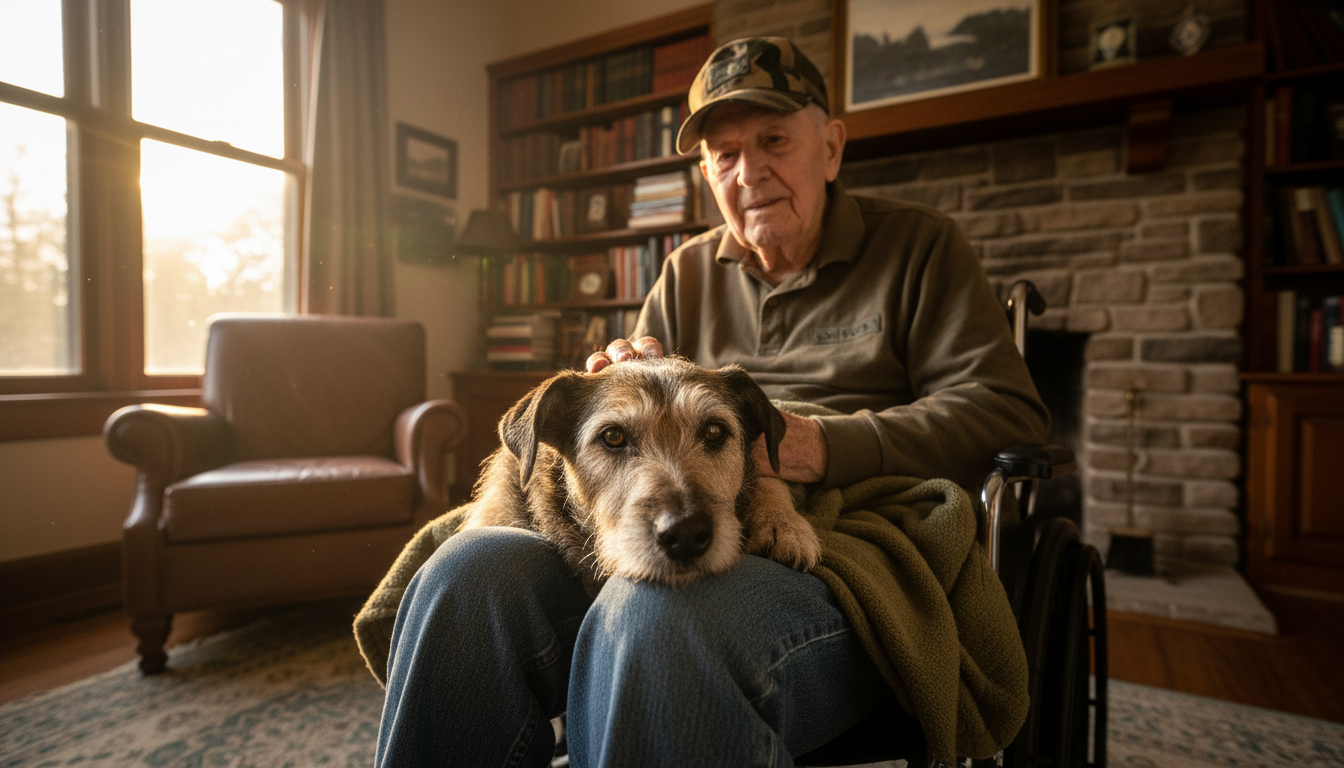
Upon arriving at the center, Arthur was given a soft orthopedic bed in the main communal lounge, though he rarely stays in it during the day. Instead, he begins his “rounds.” Staff at the center report that Arthur seems to intuitively know which residents are having a difficult day. He wanders from room to room, offering a silent companionship that professional therapists describe as invaluable.
“He doesn’t judge, he doesn’t ask for anything, and he doesn’t require you to explain why you’re sad,” one resident shared during a community open house. “He just sits with you. For a lot of us, that’s better than any medicine.”
Arthur’s role goes beyond emotional support. He has become a motivation for physical therapy. Veterans who struggle with mobility are often encouraged to take Arthur for short walks down the hallway or to brush his wiry coat, helping them improve fine motor skills and balance while caring for another living being.
The Value of Senior Dogs in Therapy
Arthur’s success highlights a growing trend recognized by organizations like The Grey Muzzle Organization, which advocates for the adoption and well-being of at-risk senior dogs. Older dogs are frequently ideal candidates for therapy and companionship roles because they have grown out of the destructive puppy phases and possess a calmness that is difficult to train.
According to research supported by the Human Animal Bond Research Institute (HABRI), interactions with therapy animals can significantly reduce cortisol levels (stress markers) and lower blood pressure. For the veterans at Arthur’s facility, the presence of a senior dog provides a sense of normalcy and home in a clinical environment.
Furthermore, the mutual benefit is undeniable. Arthur, once abandoned and unwanted, is now the most popular resident in the building. He receives high-quality veterinary care funded by the center’s auxiliary board, has a rotating roster of people to scratch him behind the ears, and never has to spend a night alone.
A New Lease on Life
Today, Arthur moves a little slower than he did when he first arrived, but his tail wags constantly. He is no longer the “invisible” dog in kennel number 42. He is Officer Arthur, the honorary mascot and chief morale officer of the center. He wears a custom vest with patches earned from various units represented by the veterans he comforts.
His story serves as a powerful reminder for those looking to adopt: the dogs often left behind—the seniors, the quiet ones, the ones with gray muzzles—often have the most love to give. Arthur didn’t just need a home to retire in; he needed a job to do. In losing his first family, he stumbled upon a destiny that allowed him to become family to dozens of people who needed him just as much as he needed them.
For more stories on the incredible impact of rescue animals, read about how a stray dog united a divided community or explore the science behind why animal companionship aids in recovery.
How to Help Senior Dogs
If Arthur’s story has inspired you, consider visiting your local shelter and asking to see the senior dogs. Organizations and shelters often have “Seniors for Seniors” programs that waive adoption fees for older adopters, or foster programs that cover medical costs for hospice dogs. By choosing to adopt a senior, you aren’t just saving a life; you are preserving a legacy of loyalty that deserves a dignified final chapter.