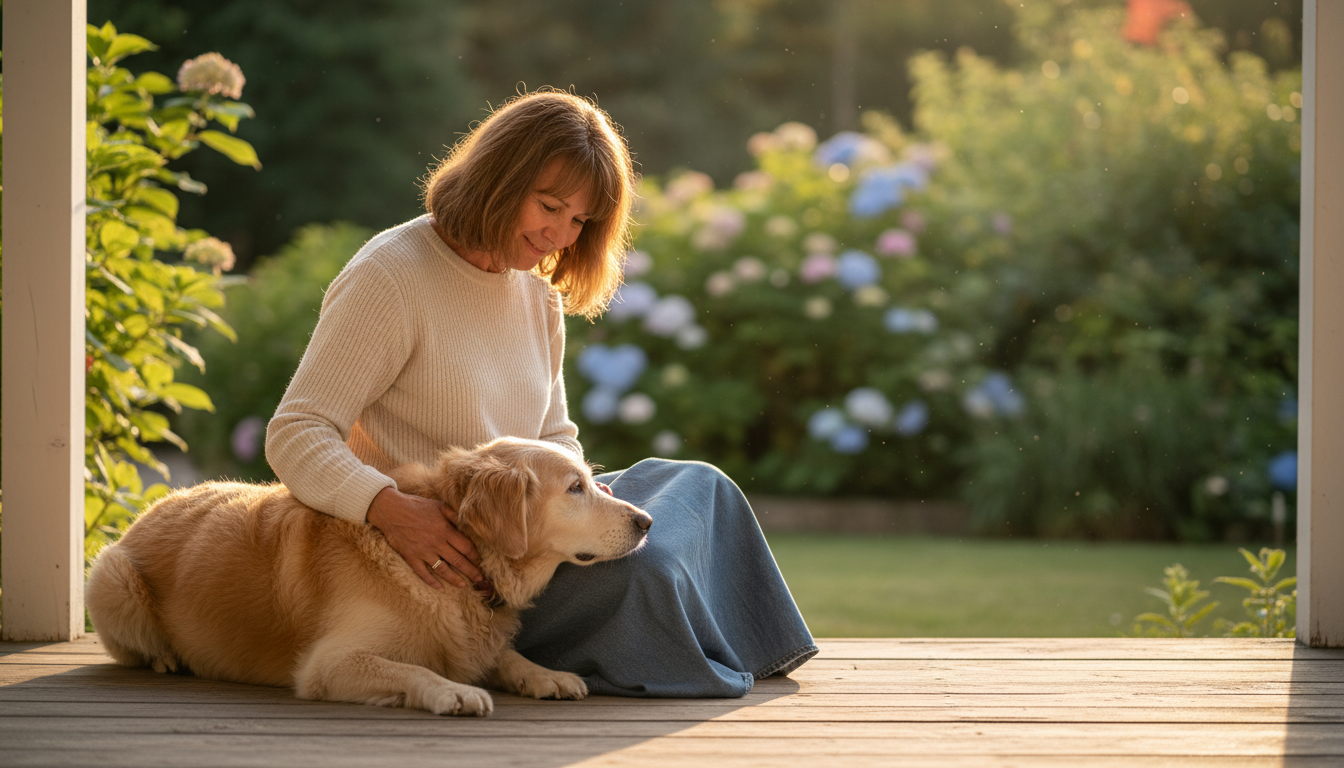
The silence in Sarah Jenkins’ hallway was deafening. For three months following the sudden passing of her husband, the 58-year-old retired nurse found herself navigating a world that felt stripped of color. The routines that had defined her life—morning coffees, evening walks, the quiet hum of companionship—had evaporated, leaving behind a profound sense of isolation. It was in this vacuum of grief that she found herself scrolling through the website of a local animal control center, not looking for a puppy or a vibrant hiking companion, but drawn inexplicably to the faces that everyone else seemed to scroll past.
That was when she saw Barnaby. Listed as a “senior intake,” the 12-year-old Golden Retriever mix looked out from the pixelated photo with clouded eyes and a matted coat. His intake notes were sparse: owner surrender, arthritis, dental disease, “hospice candidate.” He was a dog waiting to die. But where others saw a burden, Jenkins saw a mirror to her own brokenness. This senior dog rescue would become the catalyst for a transformation that neither the shelter staff nor Jenkins herself could have predicted.
The Decision to Embrace the End
Adopting a senior dog, particularly one with significant medical needs, is often viewed as an act of charity rather than an acquisition of companionship. According to data from the ASPCA, senior dogs have a significantly lower adoption rate compared to puppies and young adults, often lingering in shelters for months or facing euthanasia due to overcrowding. The emotional toll of adopting a pet likely to pass away soon is a barrier for many potential adopters.
“I wasn’t looking for a long future,” Jenkins told shelter staff during the initial meet-and-greet. “I was looking for someone to sit with in the present.”
The day Barnaby came home, he had to be carried up the front steps. He was underweight, hesitant, and clearly confused by the sudden shift in his environment. For the first week, he slept almost 20 hours a day, curling into a tight ball on the orthopedic bed Jenkins had purchased. It was a slow, quiet beginning, but it was exactly what the household needed. There was no pressure to play fetch, no demand for high-energy walks—just a mutual agreement to exist together in a quiet, safe space.
The Healing Power of Routine
The transformation began subtly. It started with the medication schedule. As a former nurse, Jenkins found comfort in the regimented care Barnaby required: pain management for his hips at 8:00 AM, eye drops at noon, supplements with dinner. These small tasks provided a scaffolding for her day, pulling her out of bed and giving her a reason to function.
Dr. Emily Carter, a veterinarian specializing in geriatric pet care, notes that this dynamic is common in human-animal bond stories. “When a human acts as a caregiver for a vulnerable animal, it triggers the release of oxytocin and dopamine, not just in the animal, but in the human,” Dr. Carter explained. “For someone grieving, having a dependent creature that offers unconditional affection can be a powerful antidote to the inertia of depression.”
By the third week, Barnaby began to change. Good nutrition and pain management allowed his personality to emerge from the fog of neglect. He began to greet Jenkins at the door with a low, thumping tail wag. He started following her from room to room, his nails clicking a rhythm on the hardwood floors that replaced the oppressive silence of the house.
A Senior Dog Rescue’s Ripple Effect
The bond deepened during their slow, meandering walks around the neighborhood. Because Barnaby couldn’t walk fast, Jenkins was forced to slow down, stopping to talk to neighbors she hadn’t engaged with since the funeral. Barnaby became a local celebrity of sorts; his frosted face and gentle demeanor drew people in.
“He was an icebreaker,” Jenkins recalled. “People would stop to pet him and ask about his story. In telling his story—that he was rescued, that he was old, that he was loved—I found I was able to start talking about my own grief in small doses.”
This phenomenon aligns with findings from organizations like The Grey Muzzle Organization, which advocates for at-risk senior dogs. Their reports suggest that senior dogs often foster a unique type of community connection, as their visible vulnerability elicits empathy from strangers. For Jenkins, Barnaby wasn’t just a pet; he was a bridge back to the land of the living.
The Unspoken Language of Empathy
One evening, roughly six months into their time together, Jenkins had a particularly difficult wave of grief. She sat on the floor of her living room, weeping. Barnaby, who usually struggled to get up from a lying position quickly, managed to hoist himself up and limped over to her. He didn’t bark or whine. He simply pressed his heavy head against her shoulder and leaned his entire weight into her.
“It was as if he knew exactly what that heaviness felt like,” Jenkins said. “He had been abandoned, he had been in pain, and he had survived. He was telling me that I could survive too.”
For more touching stories on how animals sense human emotion, read our feature on how dogs intuitively understand human grief.
Defying the Odds
When Jenkins first adopted Barnaby, the shelter veterinarian estimated he had perhaps three to six months left. However, love and proper care have a way of defying medical timelines. Six months turned into a year. A year turned into eighteen months. While his mobility remained limited, his spirit was vibrant. He experienced a “second puppyhood,” engaging in gentle play and even learning to manipulate puzzle toys for treats.
This period of extended life is a testament to the resilience of rescue animals. It serves as a reminder that a diagnosis or an age number does not dictate the capacity for joy. Barnaby’s recovery wasn’t just physical; it was a restoration of dignity.
For those considering bringing an older pet into their lives, check out our guide on preparing your home for a senior dog adoption to understand the practical steps involved.
The Legacy of a ‘Hospice’ Dog
Barnaby eventually passed away peacefully in his sleep, twenty months after leaving the shelter. But the house he left behind was no longer silent, nor was it empty of hope. Jenkins, though saddened by the loss, found that the crippling, isolating grief she had felt for her husband had been metabolized into something manageable—gratitude.
She had saved Barnaby, giving him a warm, loving end to a hard life. In return, he had saved her, pulling her out of the darkness one slow walk at a time. The senior dog rescue that everyone else had overlooked turned out to be the most vital connection of her life.
Today, Jenkins volunteers at the same shelter where she found Barnaby, advocating for the “unadoptables”—the old, the sick, and the broken. She tells prospective adopters the truth: that the heartbreak of saying goodbye to a senior dog is inevitable, but the healing they bring to your soul is worth every tear.
“I thought I was rescuing him to help him die with dignity,” Jenkins says. “I didn’t realize he was rescuing me so I could live with purpose.”