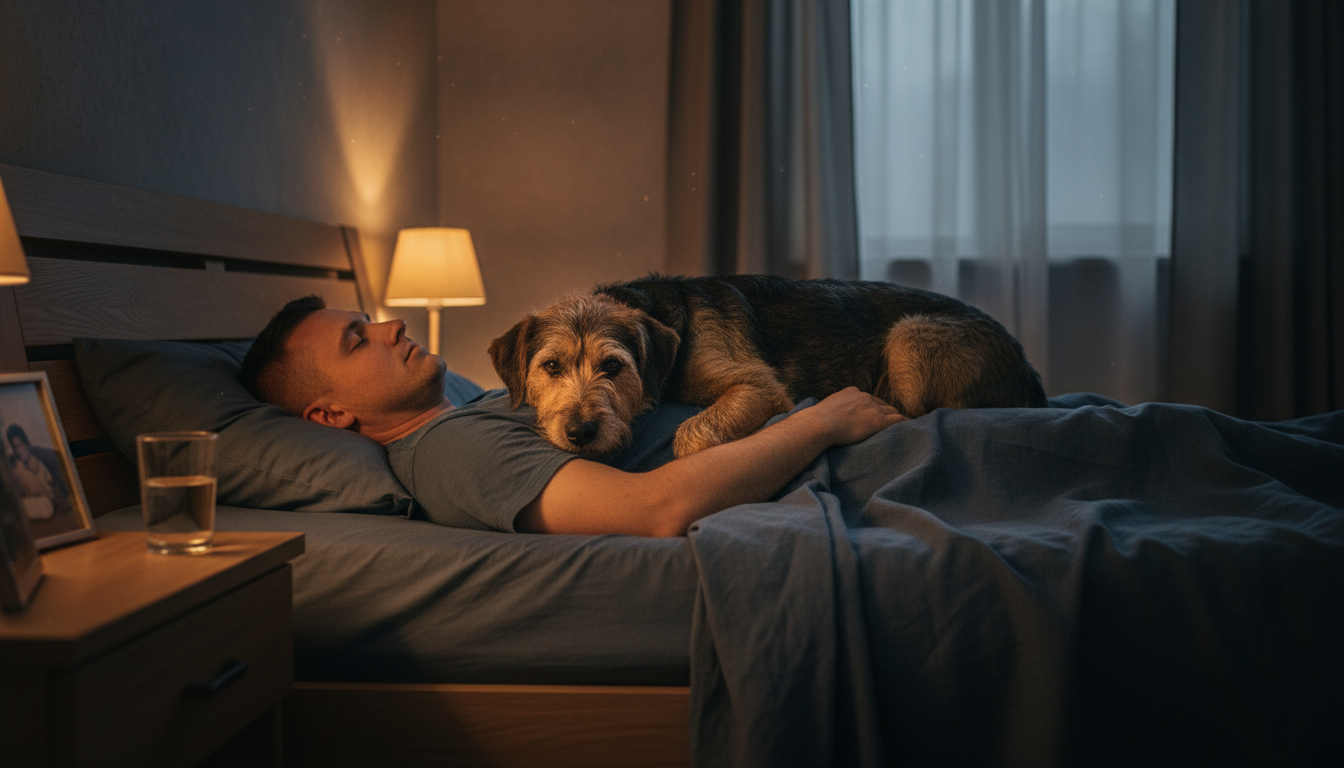
It was 3:14 a.m., and the house was silent, save for the hum of the refrigerator and the rhythmic ticking of the hallway clock. For David, a 34-year-old Marine Corps veteran, this silence was not peaceful; it was deafening. For three years since returning to civilian life, the night had been an enemy territory. Sleep was not a respite but a battleground of hypervigilance and recurring nightmares.
David’s story is not unique. According to the U.S. Department of Veterans Affairs, between 11% and 20% of veterans who served in Operations Iraqi Freedom and Enduring Freedom have PTSD in a given year. For many, like David, the primary symptom is a debilitating inability to rest. He had tried medication, white noise machines, and cognitive behavioral therapy. While they offered tools to manage the day, the nights remained a solitary struggle.
That was until a scruffy, mixed-breed dog named Barnaby walked out of a kennel and into his life. This is the story of how a shelter dog helped a veteran sleep through the night again, proving that sometimes the best medicine has a wet nose and a beating heart.
The Weight of the Quiet
Reintegration into society is often described as a jarring transition, but for David, the hardest part was the loss of the “pack.” In the military, you are never truly alone; there is always someone on watch. In his suburban apartment, the isolation was palpable. Medical professionals note that for those suffering from Post-Traumatic Stress Disorder (PTSD), the absence of a trusted companion can trigger a flight-or-fight response that makes deep sleep physiologically impossible.
David described his nights as a series of naps, interrupted by the slightest creak of a floorboard. He estimated that prior to adoption, he hadn’t slept for more than two consecutive hours in over a thousand days. The exhaustion was affecting his job, his relationships, and his physical health. It was a therapist at the local VA clinic who finally suggested an alternative path: not a prescription, but a companion.
A Visit to the County Shelter
While many organizations provide highly trained service dogs to veterans, waiting lists can be years long and costs can be prohibitive. David decided to visit the local county animal control center, hoping simply for a distraction. Staff at the shelter recall the day David walked in. The facility was loud, filled with the barking of fifty dogs clamoring for attention. David, sensitive to loud noises, almost turned around at the door.
However, a volunteer directed him toward the back of the kennel, where the older, calmer dogs were housed. Sitting quietly in run #42 was Barnaby, a dog estimated to be five years old, possibly a mix of Labrador and Terrier. Barnaby had been at the shelter for three months, overlooked because of his nondescript appearance and a slight limp from an old injury.
When David approached the cage, Barnaby didn’t bark. He simply walked to the front of the gate, sat down, and pressed his side against the wire mesh. It was a moment of recognized brokenness. Staff members noted that the connection was immediate. David took Barnaby into the meet-and-greet yard, and for the first time in months, his shoulders visibly dropped.
The First Night Home
Bringing a rescue dog home is often fraught with anxiety for both the human and the animal. The ASPCA suggests the “3-3-3 rule” regarding a rescue dog’s decompression time, but Barnaby seemed to skip the adjustment period entirely. He seemed to understand that his job was simply to be present.
On that first evening, David prepared for his usual routine: checking the locks three times, closing the blinds, and lying in bed staring at the ceiling. Barnaby, however, had a different plan. The dog jumped onto the foot of the bed—a rule David had intended to enforce but immediately abandoned—and curled up against David’s shins. The weight was grounding. This phenomenon, often utilized in Deep Pressure Therapy (DPT), helps regulate the nervous system.
For the first time, the room wasn’t empty. If there was a noise, Barnaby’s ears would perk up, but he wouldn’t bark. He would listen, determine it was nothing, and lay his head back down. David realized that he didn’t need to be on watch, because Barnaby was.
That night, David slept for six straight hours. When he woke up, the sun was streaming through the cracks in the blinds, and Barnaby was still there, snoring softly.
How a Shelter Dog Helped a Veteran Heal
The impact of that first night rippled out into the weeks and months that followed. Reports from organizations like K9s For Warriors have long substantiated the efficacy of dogs in treating PTSD, noting reductions in suicide ideation and medication usage. For David, Barnaby provided a sense of security that no lock or alarm system could emulate.
We have covered similar transformative stories on our site, including how adopting senior dogs can change lives, and the parallels are striking. The dog, having known the uncertainty of shelter life, offers a profound loyalty. The veteran, knowing the chaos of combat, offers a safe harbor. They rescue each other.
Experts in animal behavior suggest that dogs are highly attuned to human cortisol levels. When David’s anxiety spiked during a nightmare, Barnaby would often nudge him awake or lay his head on David’s chest until his breathing slowed. This bio-feedback loop became David’s anchor.
A Community Transformed
The change in David was visible to his community. Neighbors who had rarely seen him outside began to see him walking Barnaby twice a day. The dog became a social bridge, allowing David to engage in small talk about breeds and dog treats rather than feeling the pressure to explain his service or his silence.
In a reported interview with a local community newsletter, David’s sister mentioned that the difference was “night and day.” She stated that before the dog, she worried every time the phone rang. Now, she receives photos of Barnaby sleeping in ridiculous positions and hears laughter in her brother’s voice again.
It is important to note that while Barnaby was a shelter dog, the bond required work. David invested time in training, which gave him a structured purpose. The routine of feeding, walking, and caring for another living being pulled him out of his internal cycle of trauma. This aligns with findings that show responsibility for a pet significantly improves mental health outcomes.
The Ongoing Journey
Today, David and Barnaby are inseparable. While the PTSD hasn’t vanished—it rarely does completely—it is managed. The nights are no longer feared. The story of how a shelter dog helped a veteran sleep is not just about a single night of rest; it is about the restoration of hope.
Shelters across the country are full of dogs like Barnaby—animals with a few scars, perhaps a little older, waiting for a chance to serve a purpose. For veterans returning home, the key to unlocking a peaceful night’s sleep might not be found in a pharmacy, but in a concrete run at the local pound.
If you or someone you know is a veteran struggling with PTSD, consider visiting a local rescue. Somewhere behind a chain-link fence, there might be a pair of eyes waiting to watch over you so you can finally close yours.