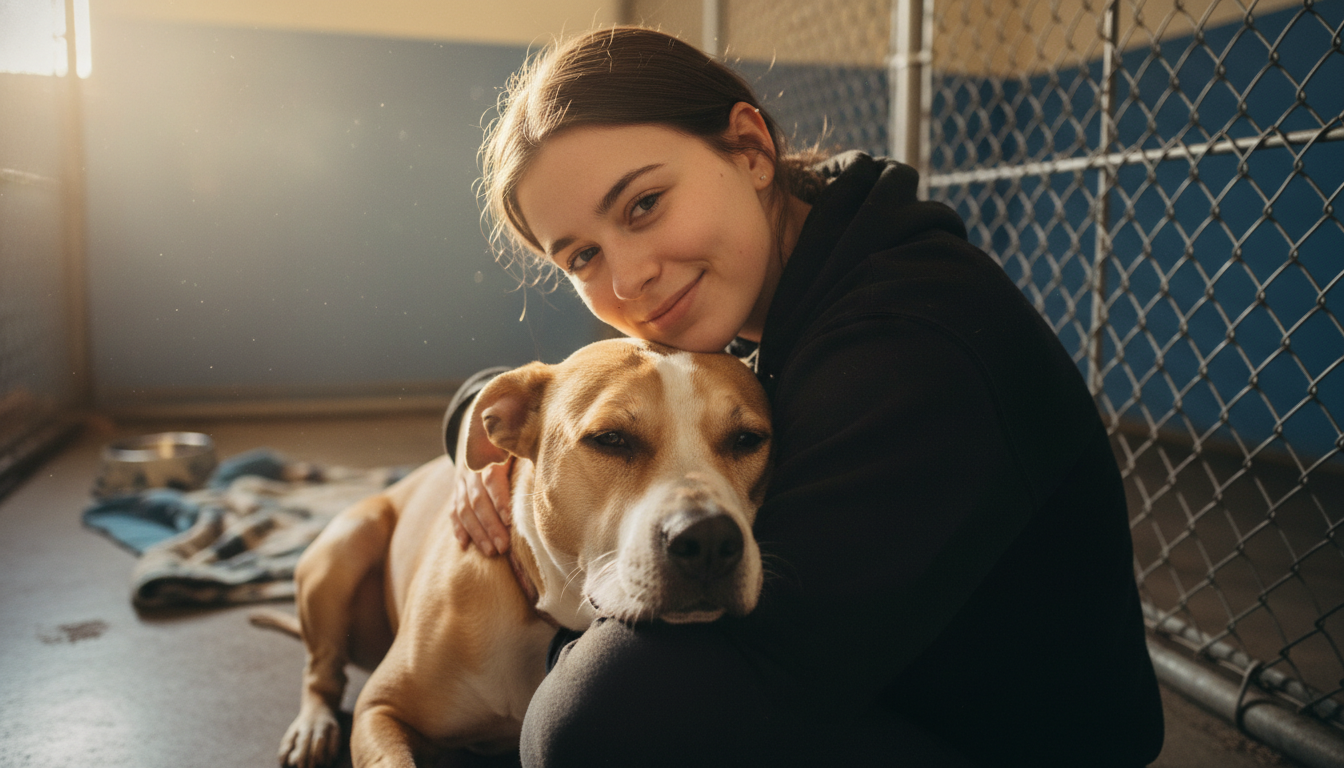
In the high-stakes, emotionally charged environment of animal control centers, stress is a constant companion. The barking is relentless, the smell of bleach is overpowering, and the heartbreak of seeing abandoned souls day after day takes a toll on even the most seasoned volunteers. Yet, amidst the chaos of ACCT Philly—the city’s open-intake shelter—one dog stood out not for his bark, but for his silence and his uncanny ability to sense when a human heart was heavy.
His name was Russ. A four-year-old Pit Bull mix, he arrived at the shelter with the odds stacked against him. His coat was patchy, his ribs were visible, and he carried the physical scars of a life lived hard on the streets. But it wasn’t his appearance that caught the attention of shelter workers; it was his soul. According to the staff and volunteers who walked the rows of kennels, Russ possessed a quiet, empathetic shelter dog quality that seemed to cut through the noise of the facility.
This is the true story of a dog who didn’t just wait to be rescued—he rescued the person who walked past his cage, proving once and for all that dogs possess a depth of emotional intelligence we are only just beginning to understand.
The Moment Everything Changed
Kayla Filoon was a volunteer dog walker at ACCT Philly, accustomed to the routine of walking dogs who were jumping, barking, and desperate for release. But when she approached Russ’s kennel, she saw something different. Russ wasn’t jumping. He wasn’t barking. He was sitting calmly, looking at her with a gaze that seemed to penetrate the steel bars between them.
“He was just sitting there, looking at me,” Filoon later told local news outlets. The connection was instant, but it was what happened next that solidified Russ’s reputation as a dog who “knows.” When Filoon took him out into the shelter yard, Russ didn’t run around or chase a ball. Instead, he walked over to her, sat down, and leaned his entire body weight against her leg.
It is a behavior animal behaviorists often describe as “contact comfort.” In a place as lonely as a shelter, Russ was seeking—and offering—solace. He seemed to sense that Filoon, like many shelter workers, carried the weight of the world on her shoulders. For the next hour, he refused to leave her side, pressing his head into her chest and closing his eyes, creating a bubble of peace in the middle of a chaotic city shelter.
The Bond Between Humans and Animals
The photograph of that moment—Russ clinging to Filoon, his head resting tenderly on her shoulder—went viral almost instantly. It struck a chord with millions of people because it captured a fundamental truth about the human-animal bond: it is a two-way street. While humans often view themselves as the saviors of shelter animals, the reality is frequently the reverse.
Shelter staff often reported that Russ had a special demeanor. In a facility where dogs are often fearful or reactive, Russ was a grounding force. See more stories about unlikely animal connections here. His behavior aligns with what researchers have long suspected about canine cognition. Studies show that dogs can read human facial expressions and even smell the chemical changes in our bodies associated with stress and cortisol.
According to the ASPCA and other animal welfare organizations, dogs like Russ often linger in shelters because they are overlooked. They are quiet and unassuming, lacking the “flashy” behaviors that attract adopters. However, these are often the dogs with the highest capacity for empathy, making them ideal companions for those struggling with anxiety or grief.
Impact on the People and Community
The impact of Russ’s story went far beyond a single viral photo. It highlighted the plight of Pit Bull-type dogs in city shelters, who often face high euthanasia rates due to overcrowding and stigma. Russ was not just a dog; he became an ambassador for the “unwanted.”
Filoon knew she couldn’t leave him there. The empathetic shelter dog who had comforted her so profoundly needed a home. She adopted him the very next day. The transition from a cold concrete floor to a warm sofa was seamless. In his new home, Russ continued to display his signature intuition. Filoon reported that whenever she had a bad day or felt overwhelmed, Russ would be there, offering the same gentle lean that had first captured her heart.
This story serves as a powerful reminder to potential adopters: do not overlook the quiet dog in the corner. The dog who isn’t barking for attention might just be the one waiting to listen to you. Read more about why adopting senior and quiet dogs changes lives.
Background & Credible Sources
Experts in canine behavior affirm that what Russ demonstrated is a genuine biological capability. A study published in the journal Learning & Behavior suggests that dogs not only recognize human distress but also have a compulsion to help. In experiments, dogs were observed trying to open doors to reach their crying owners significantly faster than when their owners were humming or talking.
Shelter workers at ACCT Philly and similar open-intake facilities often rely on these special dogs to keep morale high. “There is always that one dog,” a shelter volunteer shared in a general report on shelter fatigue. “The one who doesn’t ask for anything but just wants to be near you. They are the ones that keep us going.”
Russ’s story is a testament to the thousands of dogs currently in the system who possess this same capacity for love. They are not broken; they are simply waiting for the opportunity to heal someone.
What Happens Next
Today, Russ lives a life of luxury, far removed from the hard floors of the kennel. But his legacy remains at ACCT Philly, where volunteers still talk about the dog who hugged his way into a home. His story encourages adopters to look past breed stereotypes and physical scars to find the soul underneath.
For those visiting a shelter soon, pay attention to the dog that holds your gaze. Pay attention to the one that leans in. They might just be telling you that they know exactly what you need, even before you do.