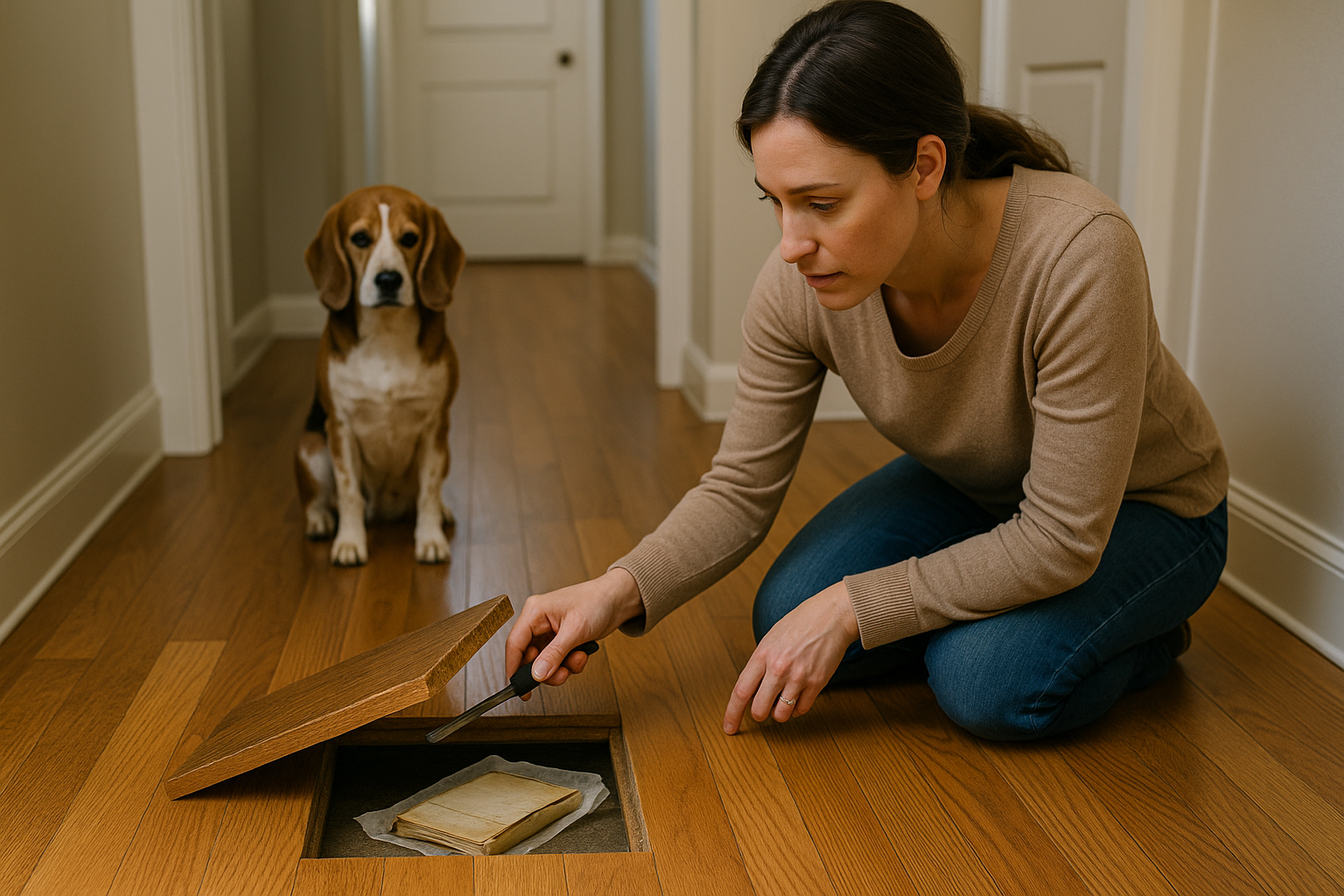
For almost a month, the Lormans’ beagle, Scout, had been refusing to walk past a narrow stretch of the upstairs hallway in their Arlington, Virginia home. At first it appeared to be an odd quirk, the sort of unpredictable behavior that dog owners learn to navigate with patience and humor. But the pattern hardened into something far more deliberate. Scout would trot confidently down the hall, only to stop abruptly at the midpoint—as if halted by an invisible barrier. He would lift a paw, back away, and stare at the hardwood boards with unusual focus, refusing to move forward unless coaxed or carried.
During the first week, the Lormans dismissed it as a passing phase. Maybe Scout heard something beneath the floor—pipes, a squirrel, old wood shifting with temperature. But as the days turned into weeks, the dog’s hesitation deepened into a form of quiet resistance. He began avoiding the hallway entirely, choosing instead to remain in rooms far from it. When he did approach, he froze at the same exact line every time, positioning himself several feet back and lowering his head anxiously, nose directed toward the boards.
Sarah Lorman, a communications manager who worked from home most days, was the first to recognize that something was truly off. She had lived with Scout for eight years and knew his temperament well. He was independent but not fearful, curious but not reactive. For him to treat a familiar hallway as if it concealed a threat—and to do so consistently—suggested a stimulus the family had not yet identified.
Her concern grew when Scout began whining softly at night, waking from sleep and pacing near the hallway entrance. On three separate nights, Sarah found him sitting rigidly upright, staring down the stretch of floor he refused to cross. When she called him, he responded immediately, but he would not take a single step toward the center point of the hall.
It was the fourth such night, sometime after 11 p.m., that Sarah finally decided she needed to investigate. She collected a phone, a flashlight, and a narrow pry bar left over from a minor remodeling project the previous year. The house was quiet, the only sound the soft tapping of Scout’s nails against the hardwood as he followed her—only to stop at his usual line, tail stiff and ears perked.
Sarah crouched and examined the floorboards closely. At a glance, nothing seemed unusual: the boards were evenly aligned, the finish was intact, and the seams showed no sign of damage. She pressed her palm against the wood, feeling for irregularities, but everything appeared solid. Still, Scout’s unbroken stare suggested something was different here, even if she couldn’t see it.
She switched on her phone’s flashlight and filmed the length of the hallway, hoping to catch angles her eyes might miss. When she reviewed the footage, one detail caught her attention. A single board, positioned almost exactly where Scout refused to step, had a slightly different grain pattern—subtle enough to escape casual notice but distinct compared to the surrounding boards. More importantly, the light reflected off it differently, as if the board had been sanded or replaced at a different time.
Sarah pressed on the board again, this time more firmly. The wood gave a faint, hollow sound—unlike the solid tone produced by the adjacent planks. Heart quickening, she positioned the pry bar at the seam. The board loosened with surprising ease, lifting just enough for her to grip and gently remove it.
Beneath it lay a narrow cavity between the joists, perhaps eight inches deep and just wide enough to store a small object. Inside the dusty space sat a thin notebook wrapped in wax paper, the edges of the cover curled with age. Carefully, Sarah lifted it out and wiped away the debris.
The notebook was densely filled with handwritten notes, sketches, and measurements. Tucked between the final pages was a folded survey map dated more than thirty years earlier. The entries detailed a structural concern involving a load-bearing wall installed during a renovation by a previous homeowner—an error serious enough to warrant documentation but apparently never formally reported. The notebook seemed to be the homeowner’s private record: a mixture of observations, warnings, and calculations.
The next morning, Sarah contacted the county office, which referred her to a structural engineer. After reviewing the notebook and inspecting the home, experts determined that the issue described in the documents was legitimate but minor—unlikely to cause imminent harm, but significant enough that the previous owner should have disclosed it. The engineer concluded that the hollowed-out space beneath the floorboard may have allowed subtle shifts in air or odor that Scout, with his sensitive nose, detected long before any human would have.
County archivists later confirmed the notebook’s authenticity and noted that homemade hidden cavities were not uncommon during renovation eras when documentation was uneven and homeowners sometimes chose to conceal concerns rather than navigate bureaucratic hurdles.
For the Lormans, the discovery offered reassurance mixed with unease. The house was safe—but it had also been hiding a decades-old story they never knew existed. And as Sarah later reflected, Scout had sensed something long before she understood what it meant.
What other histories lie hidden beneath the floors we walk across every day, waiting for the right moment—or the right animal—to bring them to light?