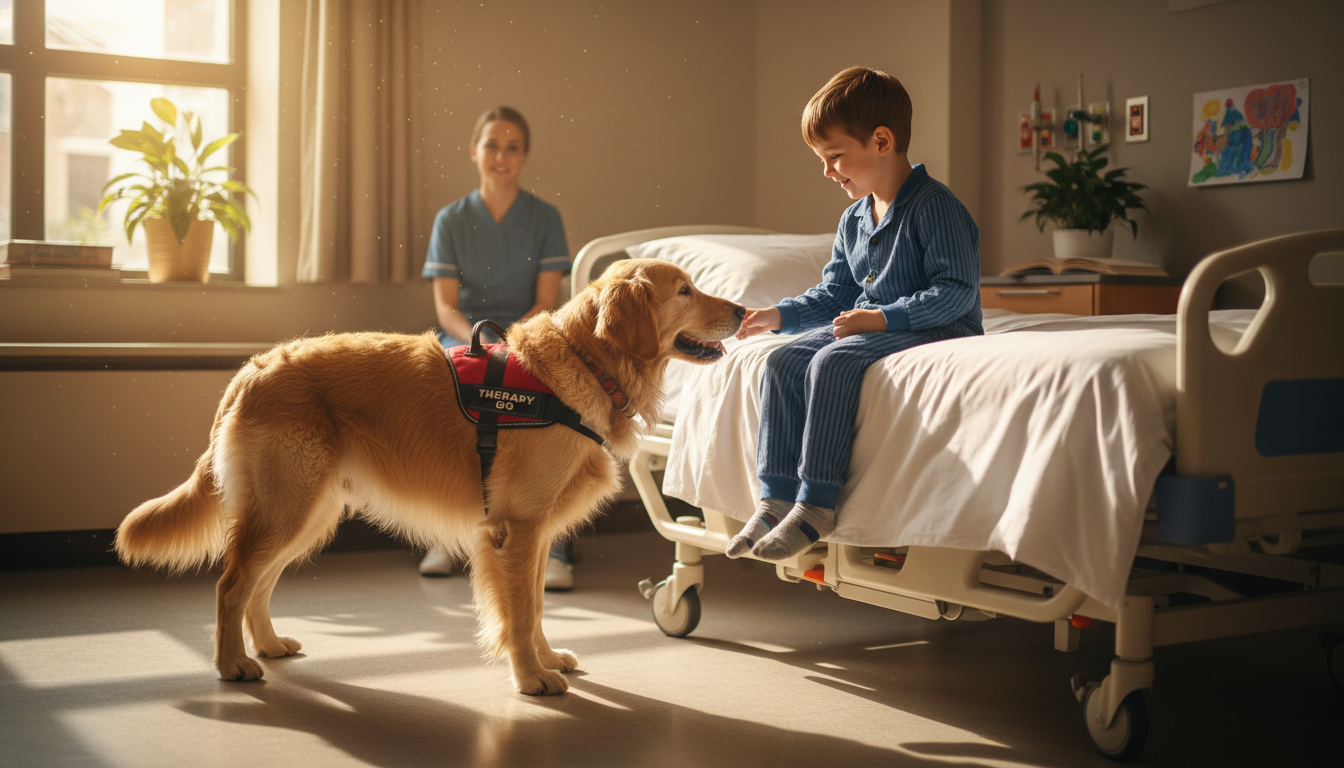
In the sterile, fluorescent-lit corridors of a pediatric rehabilitation wing, time often moves differently. For seven-year-old Leo, recovering from a complex orthopedic surgery following a serious car accident, time seemed to have stopped altogether. Despite the successful reconstruction of his leg, Leo’s recovery had hit a concerning plateau. He was withdrawn, refusing physical therapy, and struggling with pain management that medication seemed unable to touch.
It was a stalemate that frustrated his medical team and terrified his parents. That is, until a Golden Retriever named Luna trotted into Room 304. What happened over the next few weeks did not just surprise the family; it compelled the medical staff to rethink their approach to healing. Doctors say this therapy dog recovery case serves as a profound example of the tangible, physiological impact animals have on human health.
The Medical Standoff
According to hospital records and interviews with staff, Leo’s physical injuries were healing, but his spirit was broken. Trauma in pediatric patients often manifests as regression or refusal to engage, a psychological barrier that can severely retard physical healing. “The patient was medically stable but refused to bear weight on the injured limb due to fear and anxiety,” a member of the physiotherapy team noted in reports. “We were facing a significant delay in his projected release date.”
The hospital, recognizing the need for a holistic intervention, authorized a visit from their Animal-Assisted Therapy (AAT) program. This wasn’t just about cheering a child up; it was a calculated medical decision based on a growing body of evidence supporting the physiological benefits of human-animal interaction.
Enter Luna: The Four-Legged Catalyst
Luna, a certified therapy dog with three years of experience in high-stress medical environments, was introduced to Leo’s regimen. Witnesses describe the initial interaction as tentative. Leo, who had spent days staring at a tablet screen, lowered the device to watch the dog rest her chin on the edge of his bed.
The effect was almost immediate. Bio-feedback monitors in the room reportedly showed a decrease in Leo’s heart rate within minutes of the interaction. This aligns with data from the Mayo Clinic, which states that animal-assisted therapy can significantly reduce pain, anxiety, depression, and fatigue in people with a range of health problems.
The Science Behind the Healing
While the moment looked like simple puppy love, a complex chemical reaction was taking place. When humans interact with friendly dogs, the brain releases oxytocin—often called the “love hormone”—while simultaneously lowering cortisol, the primary stress hormone. For a child in a high-stress post-operative state, this chemical shift is crucial.
According to the medical staff overseeing Leo’s case, the therapy dog recovery protocol acted as a bridge. The dog didn’t just offer comfort; she offered a motivation that adults couldn’t provide. In subsequent physical therapy sessions, the therapists used Luna as a goalpost. Leo was encouraged to stand not for the sake of the exercise, but to reach Luna for a treat or a pet.
You can read more about similar unbreakable human-pet bonds on our site, where animals have stepped in when humans had run out of answers.
Accelerating the Timeline
The turning point came ten days after Luna’s first visit. Doctors noted that Leo was bearing weight on his leg two weeks ahead of the adjusted schedule. More importantly, his reliance on high-dose pain medication decreased. The distraction and comfort provided by the dog allowed his parasympathetic nervous system to take over, promoting rest and tissue repair.
“The progress we saw was nonlinear,” the lead pediatrician reportedly explained to the family. “Once the anxiety barrier was broken by the animal, the physical recovery accelerated faster than expected.”
A Ripple Effect in the Ward
Leo’s success story became a beacon for the ward. The visibility of his improvement led to an increase in requests for AAT for other children in the unit. It highlights a critical aspect of modern medicine: the acknowledgment that emotional well-being is not separate from physical health.
The impact of animals on community health is well documented. From animals changing lives in nursing homes to dogs assisting veterans with PTSD, the presence of a sentient, non-judgmental companion provides a unique form of healing. In Leo’s case, the dog offered something no surgeon could: a reason to try.
What Happens Next?
Leo was discharged three weeks earlier than the grim prognosis given during his depressive slump. While he still faces months of outpatient physical therapy, his parents credit the turnaround entirely to the intervention of the therapy dog. They are reportedly looking into adopting a Golden Retriever of their own to aid in his continued rehabilitation at home.
Doctors involved in the case have cited this as a textbook example of why integrative medicine—combining high-tech surgery with high-touch therapy like AAT—is the future of pediatric care. As for Luna, she continues her rounds, unaware that she is practically a medical marvel, happy simply to offer a paw to hold when the world feels too heavy.
Stories like Leo’s remind us that sometimes the best medicine doesn’t come in a bottle, but with a wagging tail and a wet nose.