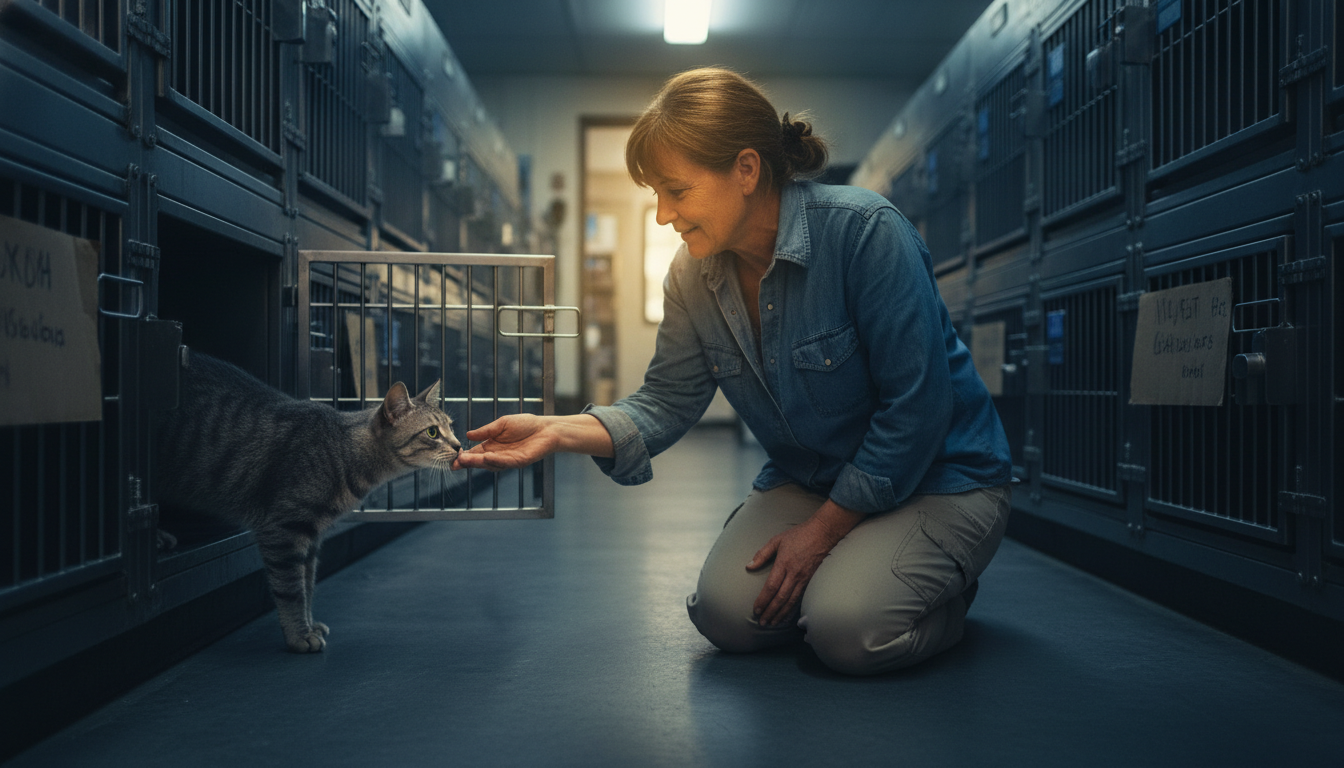
In the high-decibel chaos of a municipal animal control center, silence is often more telling than noise. While dozens of dogs bark for attention and kittens meow from the front of their cages, there are those who retreat into the shadows. These are the animals that often go unnoticed—the seniors, the shy ones, the terrified souls labeled “unfriendly” or “aloof” simply because they are paralyzed by fear. This is the story of one such overlooked shelter cat, a matted grey tabby named Benny, and the split-second decision by a volunteer that altered the course of his life forever.
It was a Tuesday afternoon, typically a slow day for adoptions but a busy one for intake. The facility was nearing capacity, a grim reality that every volunteer and staff member understands carries a heavy implication. When kennels are full, the animals with the lowest chances of adoption—often the sick, the old, or the withdrawn—are at the highest risk. Benny was sitting in a lower kennel in the isolation ward, a room reserved for animals that are either ill or struggling to cope with the shelter environment.
The Invisible Cat in the Shadows
According to intake records, Benny had been surrendered by a family moving out of state. At ten years old, he had lost the only home he had ever known. In the shelter, he didn’t hiss or scratch; he simply vanished. He pressed his body so tightly into the back corner of his stainless-steel cage that he appeared to be trying to merge with the wall. To the casual observer walking down the aisle, Cage 402 looked empty.
Sarah, a volunteer who had been walking dogs that morning, was doing a final sweep of the cat room to check water bowls. She admitted later that she was exhausted and emotionally drained, ready to head home. She glanced at Benny’s cage and initially saw nothing but a litter box and a untouched bowl of kibble. She began to turn away, assuming the cage was empty or the occupant was asleep in a hidey-box.
But then, a slight movement caught her peripheral vision. It wasn’t a meow or a reach of a paw. It was a slow, deliberate blink from the darkness. Two amber eyes were staring back at her from the gloom. That single moment of connection stopped her in her tracks. Had she kept walking, Benny’s story might have ended as a statistic. Instead, she stopped.
Saving an Overlooked Shelter Cat
The plight of the overlooked shelter cat is a well-documented phenomenon in animal welfare. According to the ASPCA, senior cats and those with “shy” behavioral notes have significantly longer lengths of stay than kittens or outgoing adults. In high-intake facilities, time is a luxury these animals do not have. Benny had already been there for two weeks with zero interest. His paperwork noted him as “depressed” and “non-responsive,” labels that can be a death sentence in overcrowded systems.
Sarah knelt down. Instead of opening the cage immediately, which can terrify a shut-down animal, she simply pressed her hand against the wire mesh and spoke softly. For five minutes, nothing happened. Then, Benny shifted. He uncurled slightly, stretching his neck toward the front of the cage. He didn’t come all the way to her, but he sniffed the air where her hand was. It was a microscopic gesture of trust, but in a shelter environment, it was monumental.
Recognizing that Benny wasn’t feral or aggressive, just heartbroken, Sarah flagged down a staff member. She requested to take him into a “meet and greet” room—a quieter space away from the barking dogs and fluorescent hum. Staff members were skeptical, noting his lack of engagement, but they agreed to let her try.
The Transformation
Once out of the cage and in a room with a soft rug and a window, the transformation was slow but undeniable. Benny didn’t hide under the chair as expected. He paced the perimeter of the room, his tail low but twitching. Sarah sat on the floor, ignoring him, reading a book on her phone to show she was no threat. This technique, often recommended by behaviorists for socializing shy cats, proved effective.
After twenty minutes, Benny approached Sarah. He sniffed her shoe, then her knee. Finally, he head-butted her hand. When she scratched behind his ears, a sound erupted from the frail cat that shocked them both: a purr so loud it sounded like a diesel engine. The “non-responsive” cat was actually starving for affection.
“He just needed someone to see him,” Sarah later told shelter staff. “He wasn’t invisible; he was just waiting for permission to exist again.”
The Ripple Effect of One Rescue
Sarah took a photo of Benny that day—not a sad photo of him cowering in a cage, but a video of him making “biscuits” on her lap, drooling with contentment. She posted it to a local community group with a caption describing the overlooked shelter cat who purred like an engine. The post went viral within the local animal rescue community.
The response was immediate. A couple who had been looking for a calm companion for their own grieving senior cat saw the video. They didn’t see a “depressed” animal; they saw a gentle soul needing a second chance. By the next afternoon, Benny—now renamed “Earl Grey”—was on his way to a forever home.
According to follow-up reports from the shelter, Earl Grey settled into his new home within days. His new owners reported that the cat who once tried to merge with a shelter wall now refuses to sleep anywhere other than the center of the bed.
Why This Matters
Benny’s story is heartwarming, but it serves as a critical reminder of the role humans play in animal welfare. Organizations like the Humane Society of the United States emphasize that volunteers are often the bridge between life and death for shelter animals. Staff members are frequently overworked and focused on feeding, cleaning, and medical protocols. Volunteers, who have the time to sit, observe, and interact, often discover the hidden personalities of animals that have shut down.
It also highlights the importance of looking past the first impression. Many adopters walk through shelters looking for the animal that runs to the front of the cage. However, many senior rescues and shy cats make the most loyal companions once they feel safe. They are merely overwhelmed by the sensory overload of the kennel environment.
Sarah continues to volunteer at the shelter, always checking the bottom cages and the dark corners first. She knows that sometimes, the best animals aren’t the ones asking for attention—they are the ones waiting for someone to care enough to look closer.
If you are considering adoption, remember Benny. Look in the bottom cages. Ask about the animals that have been there the longest. You might just find that the quietest animal in the room has the most love to give.